
What Is an Arborist and When Do You Need One? An Expert Guide
An arborist is a trained tree-care professional who assesses, prunes, supports, plants and, when necessary, removes individual trees. Unlike a general tree cutter, an arborist can read a tree’s structure, decay, pests, soil and root health and tell you whether it can be saved. You need one before removing a mature tree, after storm damage, before buying property, or when a tree suddenly changes.
Most homeowners call only after a problem becomes obvious, like a limb on the roof, a new lean, or sudden leaf drop. Across Memphis and North Mississippi, homeowners who call early usually have more options, while those who wait often face fewer choices and higher costs. This guide explains what an arborist does, what certification means, and when it makes sense to bring one onto your property.
- An arborist is a trained tree-care specialist, not just a tree cutter.
- ISA certification is one of the strongest third-party signs that an arborist has tested knowledge and continuing education.
- You should hire an arborist before removing a mature tree, after storm damage, before buying property, or when a tree suddenly changes.
- A real arborist estimate should explain the tree’s condition and the recommended work, not just list a price.
- Cheap tree work can get expensive fast if the crew skips insurance, safe rigging, cleanup, or the real cause of the problem.
What an Arborist Actually Is
An arborist is a professional trained to plant, maintain, assess, prune, support, and, when necessary, remove trees.
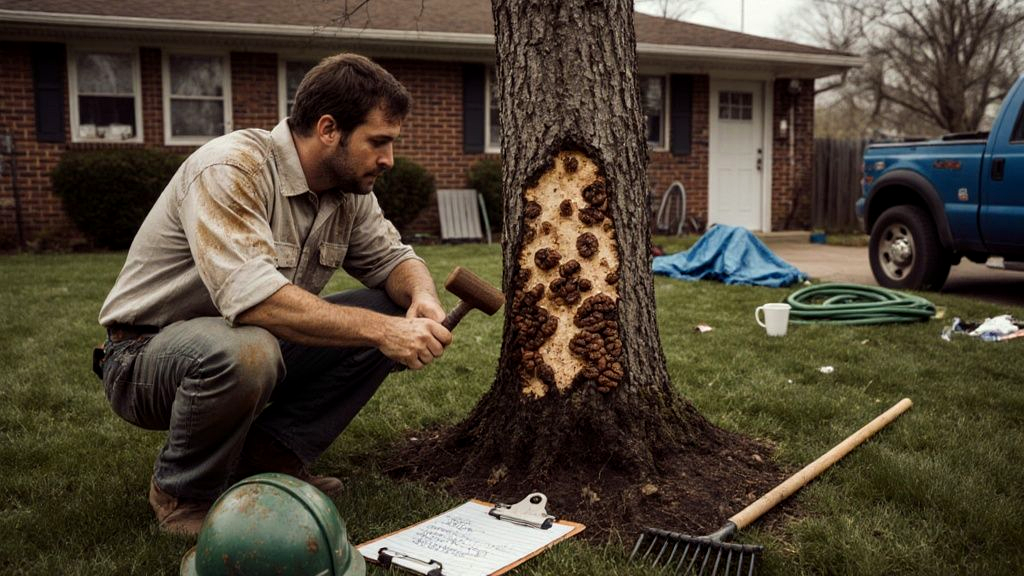
The job sits at the intersection of tree biology, structural assessment, and safe tree work. A good arborist can look at a mature pecan, identify weak branch unions, recognize decay patterns, check the root flare, and explain whether pruning, cabling, soil care, or removal makes sense.
A chainsaw operator without that training can cut wood. They cannot always tell you whether the tree should come down in the first place.
The work also reaches past pruning and removal. Arborists plant and transplant trees, install support hardware, treat pests and disease, care for compacted root zones, and write assessments or appraisals when a homeowner, insurer, or HOA needs a tree’s condition documented. Some arborists only consult. Others, like our crew at Pyramid Tree Service, pair the assessment with the climbing, rigging, and cleanup, so the people who diagnose the tree are the same team that does the work.
Arborist vs. General Tree Worker
Tree-service marketing can make every crew sound like an arborist, but those roles are not the same. Use this quick comparison to understand who you are actually hiring.
| Category | General Tree Worker | Arborist |
|---|---|---|
| Main role | Cuts, trims, hauls, and removes trees | Evaluates tree health, structure, risk, and the best course of action |
| Common experience | Saws, ropes, chippers, cleanup, and basic trimming | Tree species, pruning standards, decay signs, root health, canopy balance, and structural defects |
| Best for | Straightforward trimming, cleanup, and removal work | Diagnosing problems, deciding whether a tree can be saved, and planning safe long-term care |
| What they should explain | What work will be done and what it costs | Why the work is needed, what condition the tree is in, and what risks exist |
| Red flag | Recommends removal without much explanation | Cannot explain the tree’s condition before quoting the job |
Bottom line: If the only advice is “take it down” with no explanation, that is thin advice. A real arborist should be able to explain what is happening with the tree before recommending the work.
What ISA Certification Actually Means
The International Society of Arboriculture runs one of the most recognized arborist credentialing programs in the tree-care industry.
An ISA Certified Arborist has met experience requirements, passed an exam on tree care, and must keep the credential active through continuing education. Certification is not a government license, and it does not guarantee perfect work. But it is still one of the best ways for homeowners to separate trained tree-care professionals from crews using “arborist” as a loose marketing word.
You can verify credentials through the ISA’s consumer resource, TreesAreGood.org. If a company claims to have a certified arborist, ask for the person’s name and certification number.
Do not accept vague answers here. “We have an arborist” is not proof.
Other Arborist Credentials You May See
ISA Certified Arborist is the base credential. A few others show up on estimates and truck doors, and each points to a different specialty:
- Tree Risk Assessment Qualified (TRAQ): an ISA qualification focused on judging how likely a tree is to fail and what it would hit. Useful when the question is whether a tree over the house is safe to keep.
- Certified Arborist Utility Specialist: for arborists who clear trees near energized power lines.
- Board Certified Master Arborist: an advanced ISA level above Certified Arborist, earned through additional experience and a separate exam.
- Registered Consulting Arborist: a designation from the American Society of Consulting Arborists, common among arborists who write reports, appraisals, and expert testimony.
For most residential jobs, an ISA Certified Arborist is the credential to confirm. The specialty credentials matter more for risk disputes, utility work, or legal and insurance questions.
When You Actually Need to Hire an Arborist
Not every tree question requires a certified arborist. A small, clean limb on a young dogwood may only need a competent trimming crew. But certain situations deserve a trained set of eyes. These are the moments when guessing gets expensive.
Before You Take Down a Mature Tree
A mature shade oak can take decades to replace, so removal should never be the first guess. Before cutting it down, have an arborist check whether structural pruning, cabling, soil care, or disease treatment could solve the problem. Once the tree is removed, there is no second opinion.
If the tree is dead, declining, or hazardous, our tree removal services can help with a controlled takedown and cleanup. But the first question should always be: does this tree truly need to come down?
After a Major Storm
Storms in the Mid-South can leave trees with damage that is not obvious from the ground. A trunk crack, torn root plate, split leader, or hanging limb can turn a standing tree into a hazard.
The tree may look stable for weeks or months, then fail during the next round of wind or rain.
Call an arborist after a major storm if you notice:
- Fresh cracks in the trunk
- Large broken limbs hanging in the canopy
- Soil lifting around the root plate
- A new lean
- Bark tearing or splitting
- Heavy limbs resting on the roof, fence, or driveway
For urgent storm-related hazards, our emergency tree services are the better starting point. We answer 24 hours a day, 7 days a week, with crane service for difficult removals. Emergency work is not the time to gamble on an uninsured crew with a ladder and a pickup.
When You Are Buying or Selling Property
Healthy mature trees can make a property more appealing, but neglected trees can become a costly liability. If large trees sit near the house, driveway, garage, pool, or property line, an arborist can identify decay, weak unions, root issues, pest damage, and trees that may need pruning or removal soon.
For sellers, a written tree assessment can turn mature trees into a documented selling point instead of a concern during inspection.
The accurate point is this: healthy, well-placed mature trees can support curb appeal and property value, while hazardous trees can hurt buyer confidence.
When Something About a Tree Suddenly Changes
Trees usually show warning signs before they fail. The problem is that homeowners often miss them or wait too long.
Call an arborist if you notice:
- Leaves dropping in midsummer
- One section of canopy failing to leaf out
- Mushrooms or fungal growth near the trunk base
- Fine sawdust near the root flare
- Woodpeckers focusing on one limb
- Cracks in the trunk or major limbs
- Deadwood increasing quickly
- A new lean after rain or wind
- Bark peeling away from the trunk
These signs do not always mean the tree is beyond saving, but they do mean it needs a professional inspection. A diagnostic visit can catch problems early and help you avoid emergency removal. The sooner an arborist checks the tree, the more options you usually have.
When Trees Touch the House or Power Lines
Branches scraping shingles, growing into gutters, or pressing near a service drop are not DIY jobs. Work near structures or utility lines requires proper training, insurance, equipment, and sometimes utility coordination.
If branches are close to power lines, do not cut them yourself; call a professional tree service with the right line-clearance process.
For trees touching the roofline, rubbing the house, or crowding the canopy, our tree trimming services are often the right first step.
When You Need a Tree Appraisal or Insurance Documentation
Some tree questions are really paperwork questions: a storm-damaged tree in an insurance claim, a disagreement with a neighbor over a boundary tree, or an HOA that wants a professional opinion before a tree comes down. In those cases you need someone who can put the tree’s species, condition, and the cause of the damage in writing.
Pyramid Tree Service provides tree appraisals, and our emergency team has handled over a thousand insurance claims in Memphis, including billing insurance directly for storm removals. If a tree has already hit your home, call before cleanup starts so the damage is documented.
What a Qualified Arborist Will and Will Not Do for You
The scope of arboriculture is broader than most homeowners think, but it is not the same thing as general landscaping. Use this as a practical guide:
| Service | What You Get | Who It Is For |
|---|---|---|
| Tree health assessment | Diagnosis of species, condition, pests, decay, and recommended action | Homeowners with declining trees or property purchases pending |
| Structural pruning | Selective cuts to improve form, reduce risk, and clear targets | Mature shade trees, trees near structures, young trees being trained |
| Cabling and bracing | Hardware installed to support weak unions or reduce splitting risk | High-value trees with structural defects worth preserving |
| Removal and disposal | Controlled takedown, rigging, cleanup, and optional stump grinding | Dead, dying, hazardous, or wrong-location trees |
| Soil and root care | Mulching, aeration, decompaction, and root-zone support | Stressed mature trees or construction-impacted root zones |
| Lawn or shrub maintenance | Usually outside the scope of an arborist | Better handled by a landscaper or lawn-care provider |
An arborist’s training is in trees. Lawn and bed care is a separate skill set, so if one company offers both, ask who on the crew handles the tree work.
How to Vet an Arborist Before You Hire
The credential conversation should take five minutes. If the answers are vague, that is your answer.
Use this checklist before hiring an arborist or tree-service company:
- Ask for active ISA certification. Get the certified arborist’s name and credential number, then verify it.
- Ask for current insurance certificates. You want liability and workers’ compensation coverage in writing.
- Get a written estimate with scope. The estimate should describe the tree, the work, the equipment, the cleanup, and any add-ons.
- Ask for local references. Recent work in Memphis or North Mississippi matters more than generic advertising.
- Check whether the equipment matches the job. A large tree over a house may require rigging, a lift, or a crane.
- Ask what they would prune and why. A trained arborist can explain the cuts before anyone climbs.
- Ask whether they top trees. Topping cuts main stems back to stubs. It leaves weakly attached regrowth and large wounds that invite decay, and a trained arborist will not recommend it as routine pruning.
One more habit worth building: get two written estimates before any major tree job. Do not compare only the final price. Compare the plan.
The cheapest quote often leaves out the expensive parts: rigging, cleanup, insurance, stump grinding, or the risk assessment that should have happened before the saw came out.
Want a real assessment from a certified arborist?
Free, no-obligation written estimates across Memphis and North Mississippi.
What Does Hiring an Arborist Actually Cost?
The cost depends on the tree, the site, and the work needed.
A simple consultation or written tree-health report may cost far less than a full removal. Structural pruning on a mature tree depends on size, access, canopy condition, and how much rigging is required.
Full removals vary even more because height, location, decay, nearby structures, and cleanup all change the price.
At Pyramid Tree Service, the estimate is free and done on site by one of our certified arborists, and fees are based on the actual hours spent on the job. A large removal over a house may call for a crane, which is part of why two similar-looking trees can price very differently.
The better question is not “What does an arborist cost?”
The better question is: “What problem am I trying to solve, and what happens if I ignore it?”
Routine care on a healthy tree is usually cheaper than emergency work on a neglected one. A careful structural prune can also flag early issues before they become removals.
For trees that need shaping, clearance, or canopy work rather than removal, start with Pyramid’s professional tree trimming services. A good trimming visit can improve structure and reveal whether deeper arborist attention is needed.
Frequently Asked Questions
Is an arborist the same as a tree cutter?
No. A tree cutter removes wood. An arborist is trained to decide whether wood should come off at all, which cuts to make, and what the tree needs afterward. Many arborists also do the cutting themselves, but the training behind the decision is the difference.
Is every arborist also a tree-removal company?
No. Some are consulting-only and do not own removal equipment. Some are full-service crews like ours that handle the diagnostic side and the climbing and rigging too. Ask up front so the scope of what they can do matches what you actually need.
How do I verify a certification claim?
Use the public ISA directory. Search by name, company, or certification number. The lookup takes a minute and shows the credential status, the expiration date, and any specialty endorsements. If the result does not match the claim on the truck door, that tells you something.
How long does it take to become a certified arborist?
The ISA requires three or more years of full-time, hands-on experience in arboriculture before a candidate can sit for the Certified Arborist exam. A degree in arboriculture, horticulture, or forestry can shorten that requirement. After passing, the arborist has to keep earning continuing education credits to keep the credential active.
Do I need a permit for tree work on my property?
Usually not for pruning or removing a tree on your own residential lot, but rules vary by city and neighborhood. Trees in a public right-of-way, near utility lines, or covered by HOA covenants may need approval first. A good crew asks about this during the estimate and helps with the paperwork if anything is required.
Will an arborist try to talk me out of removing a tree?
A good one will give you an honest answer either way. If the tree can be saved with a prune, cabling, or soil work, that is the recommendation. If it is a hazard, you will hear that just as clearly. The bias of a trained pro is toward the right outcome for the tree and the property, not toward whichever invoice is bigger.
How often should mature trees be inspected?
Every three to five years for a healthy specimen, annually for anything older, larger, or hanging over a structure. After any major storm, walk the property and call for a professional look at anything that does not seem right. Catching a problem at the inspection stage is always cheaper than catching it at the emergency stage.
Can an arborist also help with new tree planting?
Yes. Species selection, placement, soil prep, and the first-year care plan are exactly the kind of work a trained pro does well. Most expensive tree problems start with the wrong species planted in the wrong spot ten or twenty years earlier. A short consult at planting time saves a long, expensive conversation down the road.
Get a real arborist on your property.
Twenty minutes on site, no pressure, real answers. The fastest way to stop guessing about a tree is to have a certified pro walk the property and put the assessment in writing. We answer 24 hours a day, 7 days a week, or you can send the details through our contact page.