
Potassium Nitrate for Stump Removal: A Safe, Proven Step-by-Step Guide
If you are considering potassium nitrate for stump removal, the main thing to know is simple: it can help a stump decay faster, but it will not make the stump disappear overnight. This method is best for small, out-of-the-way stumps when you are not in a hurry to reuse the space.
Potassium nitrate stump remover works by supporting the natural breakdown of dead wood. The process still depends on moisture, time, wood type, stump size and how well the product is applied.
For some homeowners, that slow timeline is fine. For others, especially if the stump is in the middle of a lawn, near a driveway or blocking a landscaping project, waiting months is not realistic. Here is what potassium nitrate actually does, how to use it more safely and when stump grinding is the better option.
- Potassium nitrate accelerates decay by feeding the fungi that break down wood. It does not chemically melt the stump.
- Expect six to twelve months for full breakdown, and longer for dense hardwoods like oak, hickory, and pecan.
- The granules are a strong oxidizer, so fire safety and careful storage matter more than most guides admit.
- This method works best on small, out-of-the-way stumps when you are in no rush to reuse the spot.
- Large stumps, anything near structures, or a spot you need back this season are jobs for a grinder, not a bag of powder.
What Potassium Nitrate Actually Does to a Stump
Potassium nitrate, also known as saltpeter, is commonly used in stump remover granules because it helps support the natural decomposition of dead wood. It does not work like acid or hollow out a stump within a few days. Instead, it adds nitrogen and moisture to the wood, creating better conditions for bacteria and fungi to break the stump down over time.
This matters because fresh stumps, especially dense hardwood stumps, can sit in a yard for years before they naturally rot away. Drilling holes into the stump and adding potassium nitrate with water helps the treatment reach deeper into the wood, where decay can begin more effectively.
Most DIY guides oversell potassium nitrate stump removal as a fast shortcut, but that is not accurate. It is better understood as a way to speed up a slow natural process. If the stump is hidden and you are not in a hurry, it may be worth considering, but if you need the area cleared for sod, a patio or replanting, stump grinding is usually the better choice.
What You Need Before You Start
This is a low-cost project, which is a big part of its appeal. A bag of stump remover granules runs roughly fifteen to forty dollars and is enough for one or two average stumps. Gather everything before you begin so you are not stopping halfway through with an open container of oxidizer sitting in the sun.
- Potassium nitrate stump remover granules, one to two pounds per stump depending on diameter.
- A drill with a wide spade or auger bit, ideally one inch or larger, plus an extension bit for depth.
- A chainsaw or handsaw to cut the stump as low to the ground as you safely can.
- A bucket of warm water to activate the granules and keep the wood damp.
- Plastic sheeting or a tarp to cover the stump and hold moisture in between treatments.
- Safety gear: goggles, chemical-resistant gloves, and a dust mask for when you pour.
Using Potassium Nitrate for Stump Removal Step by Step
The steps are not complicated, but they need patience. Most failed attempts happen because the stump is too fresh, the holes are too shallow, or the wood is allowed to dry out.
-
Cut the stump low and fresh
Cut the stump as close to ground level as you safely can so there is less wood to break down and remove later. Create a flat surface across the top to give yourself enough room to drill several holes and help the potassium nitrate reach deeper into the stump. Do not use a chainsaw for this step unless you are properly equipped and experienced, since cutting near soil can quickly dull the chain if it hits dirt, rocks or embedded grit.
-
Drill a grid of deep holes
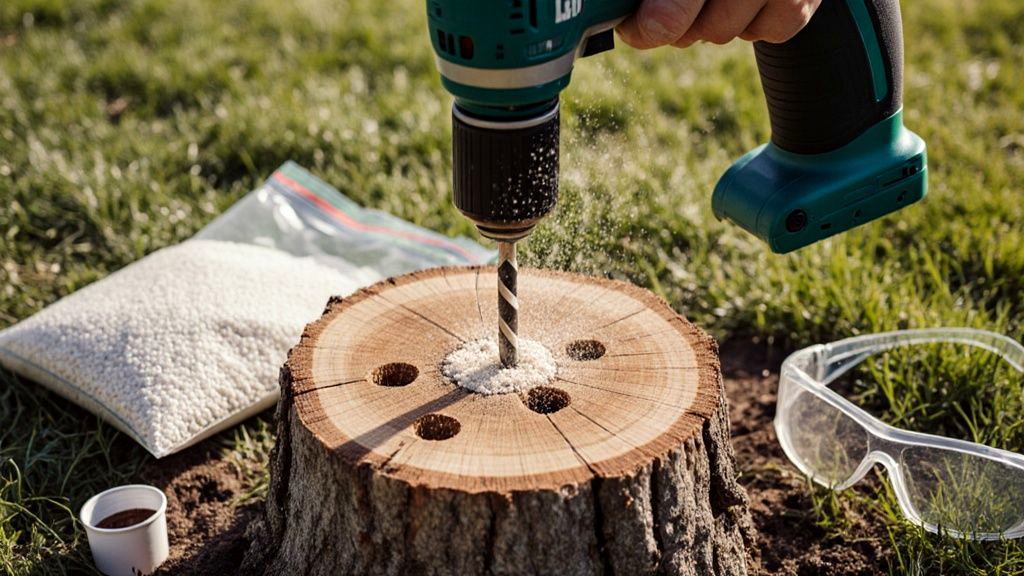
Drill several holes into the top of the stump, spacing them a few inches apart and making them wide enough to hold the granules. For larger stumps, add angled holes around the sides so they connect with the vertical holes and give the water and potassium nitrate more pathways into the wood. A few shallow surface holes will not do much, so the goal is to create enough contact between the treatment and the stump to support deeper decay.
-
Add the potassium nitrate granules
Pour the potassium nitrate stump remover granules into the drilled holes according to the product label, while wearing gloves and eye protection and avoiding the dust. Use potassium nitrate with water only, and never mix it with chemicals, fuel, oil or accelerants. Keep the container closed when not in use and store any unused product in a cool, dry place away from heat, sparks, gasoline, fertilizer and flammable materials.
-
Add warm water slowly
Pour warm water slowly into each treated hole until the granules are saturated, allowing the potassium nitrate to dissolve and move into the wood fibers. Avoid blasting the holes with water or washing the granules onto the lawn. After treatment, keep the stump damp but not flooded, since decomposition slows down when the wood dries out completely.
-
Cover the stump and wait
Cover the stump with plastic sheeting or a tarp to help retain moisture, and weigh down the edges so it stays in place. Check the stump every four to six weeks, add more water if the holes are dry, and only reapply granules if the product label allows it. This step takes patience because potassium nitrate for stump removal depends on gradual wood decay, not an instant chemical reaction.
-
Break up the softened wood
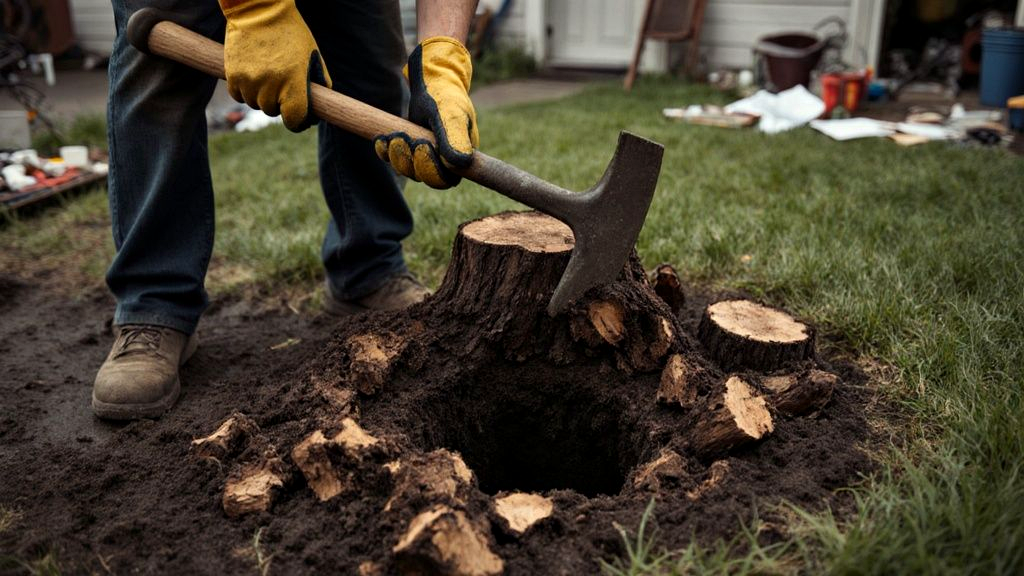
Once the stump becomes dark, spongy and crumbly, break it apart with a mattock, axe or digging tool. Remove the loosened wood and as much decayed material as possible, then backfill the hole with clean topsoil and level the area. If you plan to grow grass, use fresh soil instead of leaving rotten wood behind, since leftover material can settle and create a low spot in the lawn.
Safety Rules You Cannot Skip
Most guides treat this as a harmless garden chore, and that is where people get into trouble. Potassium nitrate is an oxidizer, which means it does not burn on its own but it feeds and intensifies any fire it contacts. That single fact drives almost every safety rule worth following.
- Keep it away from heat and sparks. Store the bag sealed, cool, and dry, well away from fuel, fertilizer, and anything flammable in the garage or shed.
- Do not mix it with other chemicals. Combining oxidizers with the wrong substances can create a real fire or reaction hazard. The granules go in plain, with water only.
- Think hard before you burn the stump. Some old guides finish by igniting the saturated stump. A nitrate-soaked stump burns hot and unpredictably, fire can travel underground through roots, and open burning is restricted or banned across most of the Memphis area. We do not recommend it on residential lots.
- Protect kids and pets. Cover treated holes and fence off the area. The granules and the rotting wood are not something you want little hands or paws in.
- Wear eye and skin protection every time you pour or add water, and wash up afterward.
For homeowners who want a trustworthy baseline on safe tree care and how to vet a qualified professional, the International Society of Arboriculture publishes plain-English consumer guidance and a free directory of credentialed arborists at TreesAreGood.org. It is a good reference point before you take on any project involving chemicals or power equipment near your home.
Rather skip the year of waiting?
Free estimates and same-week stump grinding across Memphis and North Mississippi.
Realistic Timeline and What to Expect
The biggest frustration with potassium nitrate for stump removal is the waiting. For the first few weeks, the stump may look almost unchanged. That does not always mean the method failed. Decay starts inside the wood and works slowly.
Here is a realistic timeline:
| Timeframe | What is happening | What you should do |
|---|---|---|
| Weeks 1 to 6 | Nitrogen spreads through the wood, fungi begin colonizing. Little visible change. | Keep it covered and re-wet the holes. |
| Months 2 to 4 | Outer wood softens, color darkens, edges start to crumble. | Add a second dose of granules, keep moist. |
| Months 4 to 8 | Wood becomes spongy and punky most of the way through. | Test with a screwdriver; begin breaking it up. |
| Months 8 to 12+ | Hardwoods like oak and pecan finally give way. | Mattock out the remains, backfill the hole. |
Softwoods such as pine and poplar can finish on the faster end. Dense Memphis-area hardwoods routinely take the full year or more.
If a timeline measured in seasons does not fit your plans, that is the clearest signal that a different approach makes more sense. A weekend of grinding accomplishes what a year of chemistry does, and we walk through that tradeoff next.
When Potassium Nitrate Is the Wrong Tool
Choosing potassium nitrate for stump removal honestly comes down to the stump in front of you, not a sales pitch. The granules are genuinely the right call for a small, soft, out-of-the-way stump when you have time and patience to spare. They are the wrong call more often than the internet admits. Reach for a professional instead when any of these are true:
- The stump is large or a dense hardwood. Oak, hickory, and pecan over about eighteen inches across can resist chemical decay for well over a year.
- It sits near your house, driveway, fence, or utilities. Soaking wood and roots next to structures, then possibly involving fire, is not a risk worth taking.
- You need the spot back soon for grass, a patio, replanting, or a building project this season.
- You have several stumps. The chemistry has to run separately on each one, while a grinder clears them all in a single visit.
In all of those cases, grinding is faster, cleaner, and finished the same day. Our professional stump grinding services take a stump and its surface roots eight to twelve inches below grade in well under an hour, so the spot is immediately usable for sod or planting. If the tree itself is still standing or only partly down, we also handle complete tree removal and stump elimination in one coordinated job rather than leaving you with a stump to fight later.
If you would rather weigh every option side by side before deciding, our guide on smart DIY versus professional stump removal methods compares chemicals, grinding, digging, and excavation on cost, time, and risk. And because price is usually the deciding factor, our breakdown of tree work costs and hidden fees shows what actually lands on a typical invoice.
Final Takeaway
Potassium nitrate for stump removal can work, but only if you are willing to wait. It is best for small, low-priority stumps that can decay over several months. For large hardwood stumps, visible front-yard stumps or areas you need cleared soon, stump grinding is the better option.
Before buying anything, check the stump’s size, location and how soon you need the area cleared. If it is large, close to structures or blocking a project, potassium nitrate may not be worth the wait. For a faster and cleaner result, review our stump grinding services and request a free estimate.
Potassium Nitrate Stump Removal Questions We Hear Most
How long does potassium nitrate really take to rot a stump?
Plan on six months at the absolute minimum, and a full year or more is realistic for hardwoods in our humid climate. The granules do not dissolve wood on contact. They speed up natural decay, which is a biological process that moves at its own pace no matter how much product you add.
Is potassium nitrate the same as Epsom salt for stumps?
No. Epsom salt is magnesium sulfate and works mainly by drying the stump out, which can take even longer and is less reliable. Potassium nitrate adds nitrogen that feeds decay organisms directly. They are different compounds with different mechanisms, so do not assume advice about one applies to the other.
Can I plant grass or a new tree where the stump was?
Once the rotted wood is broken up and removed and you backfill with clean topsoil, grass grows fine. Planting a new tree in the exact same hole is trickier, because leftover roots and decaying wood interfere with establishment. For replanting in the same spot, full removal of the root ball is the better route.
Will the granules harm my surrounding lawn or plants?
Kept inside the drilled holes and under a cover, the nitrogen stays concentrated in the stump. The risk comes from spills and runoff, which can scorch nearby grass with excess nitrogen or pose a hazard to pets. Pour carefully, cover the stump, and rinse any granules that miss the holes.
Should I burn the stump after treating it?
We advise against it. A nitrate-saturated stump burns hot and unpredictably, fire can smolder along roots underground and surface feet away, and open burning is restricted across most of the Memphis area. The small savings are not worth a fire that gets away from you. Let the wood rot, then dig it out.
Stump still standing? Let us finish it this week.
Chemistry takes a year. A grinder takes an afternoon. If you would rather skip the wait, we will walk your property, give you a free no-pressure estimate, and have most stumps gone within the week.