Tree Removal and Trimming: The Essential Expert Guide to Choosing the Right Service
Most people who ask about tree removal and trimming already have an answer in mind. The big tree is scary, so it should come down. The small tree looks fine, so it can stay. Half the time that instinct is right, and the other half it is exactly backwards. The right choice comes down to three questions: what is actually wrong with the tree, what it would hit if it failed, and what each option costs you over the next ten years, not just this week. This is how we answer them on Memphis properties, and how you can start sizing up your own trees before anyone shows up with a saw.
- Trimming fixes problems in the branches. Removal fixes problems in the trunk, the roots, or the tree’s location.
- If roughly half the crown is dead or broken, or decay has hollowed out much of the trunk, removal is usually the safer call.
- As a rule of thumb, a healthy tree should not lose more than about 25 percent of its live canopy in one season, and mature trees often less. A quote that cuts more is a red flag.
- Trimming costs less per visit but recurs. Removal costs more once, and waiting on a dying tree makes it more expensive.
- The size of a tree tells you very little. Fungus at the base, cracks, and a fresh lean tell you a lot.
The Tree You Want Gone Is Not Always the One That Should Go
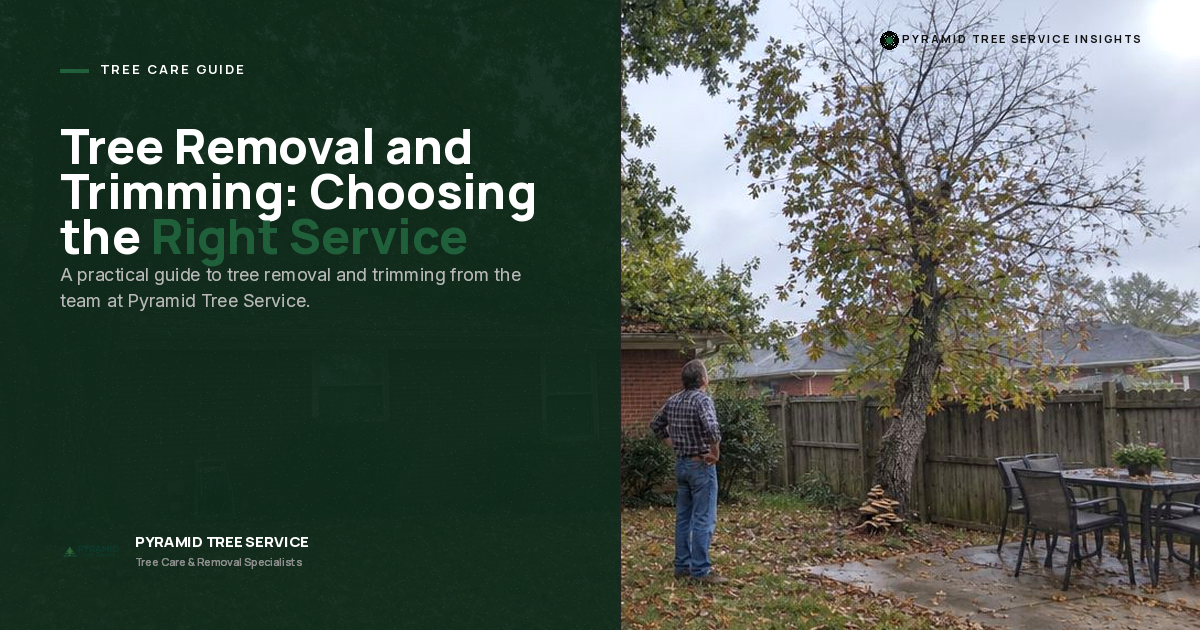
We see some version of this all the time. A homeowner calls about a big water oak behind the house. One long limb has grown out over the roof, it scrapes the shingles every time the wind picks up, and the gutters fill with leaves twice a fall. They want the whole tree gone. Near the back fence there is a smaller pin oak they like because it shades the patio, and they want it left alone.
Then we walk the yard. The water oak is solid: tight bark, a full canopy, no cracks, a root flare that sits cleanly on the soil. Its only problem is that one limb, and a reduction cut back to a healthy lateral branch solves it in an afternoon. The pin oak is a different story. There is a cluster of shelf fungus at the base, the top third of the crown is bare, and a screwdriver sinks into the wood at the root flare like it is going into a cork. That is the tree that needs to come down, and it is leaning toward the patio where the family eats dinner.
Size and annoyance are not safety signals. A big tree with a branch problem is a trimming job. A modest tree with a trunk or root problem is a removal job, no matter how pretty it looks from the kitchen window.
“They came within a week and completed the job (removed one tree and trimmed a second tree) in 2.5 hours. The trimmed tree looks great.”
Jeff C. · Google reviewWhen Trimming Is the Right Call
Trimming makes sense when the tree itself is sound and the trouble lives in the branches. A good crew removes the specific wood that creates risk or crowding and leaves the rest of the tree to keep growing. Our expert tree trimming usually falls into one of these situations:
- Deadwood overhead. Dead limbs over a roof, driveway, or play area drop without warning. Taking them out is often the single biggest safety gain you can buy for a healthy tree.
- Clearance problems. Limbs rubbing the roof, blocking a chimney, or hanging low over a driveway can be reduced or raised without touching the trunk.
- Limited storm damage. A torn branch or a hanger caught in the crown is a cleanup and pruning job if the trunk and main stems came through intact.
- A dense, wind-catching crown. Selective thinning lets wind pass through rather than pushing against the canopy like a sail.
- Young trees with weak structure. Correcting a split leader or crossing limbs early can prevent a removal fifteen years from now.
One rule keeps trimming from turning into damage. Widely used arborist guidance, including the International Society of Arboriculture’s homeowner pruning advice, treats about a quarter of a tree’s live foliage as the upper limit for a single growing season, and mature trees usually tolerate less than that. Leaves are how the tree feeds itself, and stripping too much at once stresses it and invites decay. If a quote involves cutting the whole top off a healthy tree, that is topping, not trimming, and it creates a weaker tree than the one you started with.
Branches tangled in a power line are a separate case. Stay clear and contact your utility first. Line clearance is specialized work, and no homeowner should be anywhere near it.
When Removal Is the Safer Choice
Removal becomes the right answer when the problem is structural, meaning no amount of pruning can fix it. These are the findings that move us toward recommending professional tree removal services:
- Half the tree is dead or broken. A common rule of thumb among arborists is that once about 50 percent of the crown is dead, damaged, or missing, recovery is unlikely and the remaining wood becomes unpredictable.
- Serious trunk decay. Fungus or mushrooms at the base, soft or crumbling wood, and large cavities point to internal rot. A widely used field guideline holds that when the sound shell around a hollow is thinner than roughly a third of the trunk’s radius, failure risk climbs sharply.
- A new lean with heaving soil. A tree that has always leaned is often fine. A tree that started leaning after a storm, with soil cracked or lifted on the opposite side, is actively failing.
- Major root damage. Trenching, driveway work, or grade changes that severed big roots on one side can leave a tree with a full canopy and almost nothing holding it up.
- Wrong tree, wrong place. A tree pushing on a foundation, lifting a slab, or growing into a structure will keep doing it. Trimming only buys time.
Removal is permanent, so it deserves a careful look. But a tree that fails on its own picks its own landing spot, and it is rarely the one you would choose.
How We Run a Safety Assessment on Tree Removal and Trimming Decisions
A real assessment is not someone glancing up from the truck. On a typical visit we check four things, roughly in this order.
First, the target. What would the tree or its biggest limbs hit if they came down? A dead branch over an empty back lot and the same branch over a bedroom are two very different risks. Target drives urgency as much as the tree’s condition does.
Second, the root flare and base. This is where that pin oak gave itself away. We check for conks and mushrooms, probe any soft spots, and sound the trunk with a mallet. Solid wood rings; decayed wood thuds. We also look for girdling roots wrapping the trunk and for soil heaving that signals root movement.

Third, the trunk and unions. Vertical cracks, seams, and V-shaped unions where two stems meet with bark trapped between them are common failure points. Some can be cabled. Others cannot.
Fourth, the crown. How much is dead, whether the dieback is at the tips (often stress) or whole limbs (often structural), and whether there are hangers waiting to drop. The International Society of Arboriculture’s tree owner resources on recognizing tree risk is a good primer if you want to walk your own yard with this checklist before calling anyone.
After that walk, the recommendation usually becomes obvious: trim, cable and monitor, or remove. If someone cannot explain which of these findings drove their recommendation, ask for a second opinion.
Not sure which tree is the real problem?
We will walk your yard, check every tree you are worried about, and give you a free written estimate.
Comparing the Cost of Tree Removal and Trimming
Price usually tips the decision. In the Memphis area, a typical single-tree job breaks down roughly like this:
| Tree height | Typical trimming | Typical removal |
|---|---|---|
| Under 25 ft | $150 to $350 | $250 to $500+ |
| 25 to 50 ft | $300 to $1,000 | $500 to $1,000+ |
| 50 to 75 ft | $550 to $1,800 | $1,000 to $1,800+ |
| 75 ft and up | $900 to $1,800+ | $1,800 to $3,500+ |
The per-visit numbers favor trimming, but the long-run math is more interesting. A healthy shade tree may need maintenance pruning every three to five years. Over a decade, that can add up to more than a one-time removal. If the tree is healthy and you value the shade, that is money well spent. If you are paying every few years to manage a tree that is slowly declining, you are funding a removal in installments. For the details on each, see our guides to tree trimming pricing and how to estimate the cost of tree removal.
There is also a cost to waiting. A dead tree dries out and turns brittle, and brittle wood cannot safely carry a climber or a rigging line. A removal that a climber could have handled last spring may need a bucket truck or a crane this fall, especially when the tree stands over a house. Delaying a removal rarely saves money.

How to Find an Affordable, Reliable Crew
The cheapest quote is not always the affordable one. A low bid that skips insurance, leaves the brush in your yard, or over-cuts a healthy tree ends up costing more. Before you hire anyone for tree removal and trimming, ask:
- Are you licensed and insured, including liability and workers’ compensation? Ask for the certificate, not just a yes.
- Can you show me what you found? A good estimator points to the decay, the crack, or the dead limb that drove the recommendation.
- Would trimming work instead? An honest crew will tell you when a tree can be saved, even when removal is the bigger ticket.
- What does cleanup include? Chipping, hauling, raking, and stump grinding should be spelled out in writing.
- How will you protect the house and lawn? Rigging plans, ground protection, and equipment choice matter most on tight lots.
Frequently Asked Questions
Can a leaning tree be saved with trimming?
Often, yes, if the lean is old and the roots are sound. Reducing weight on the heavy side can help. A lean that appeared suddenly, especially with cracked or lifted soil at the base, usually means the roots are failing and the tree should come down.
Is it cheaper to trim a tree or remove it?
Trimming is cheaper per visit. Removal is a one-time cost. For a healthy tree, trimming is the better value. For a tree in decline, repeated trimming often costs more than removal over a few years and leaves the risk in place.
How do I know if tree removal and trimming are both needed?
The assessment will show it, and it happens a lot on older properties. One tree may have trunk decay that calls for removal while its neighbor only needs deadwood and clearance work. Booking both in a single visit usually saves on setup and cleanup.
What time of year is best for trimming?
Late fall through winter is ideal for most species because the tree is dormant and the structure is easy to see. Dead, broken, or hazardous limbs should be handled any time of year.
Get a straight answer on every tree in your yard.
Careful trim or safe removal, we will tell you which each tree needs and why. Free on-site estimates across Memphis, with full cleanup on every job.