
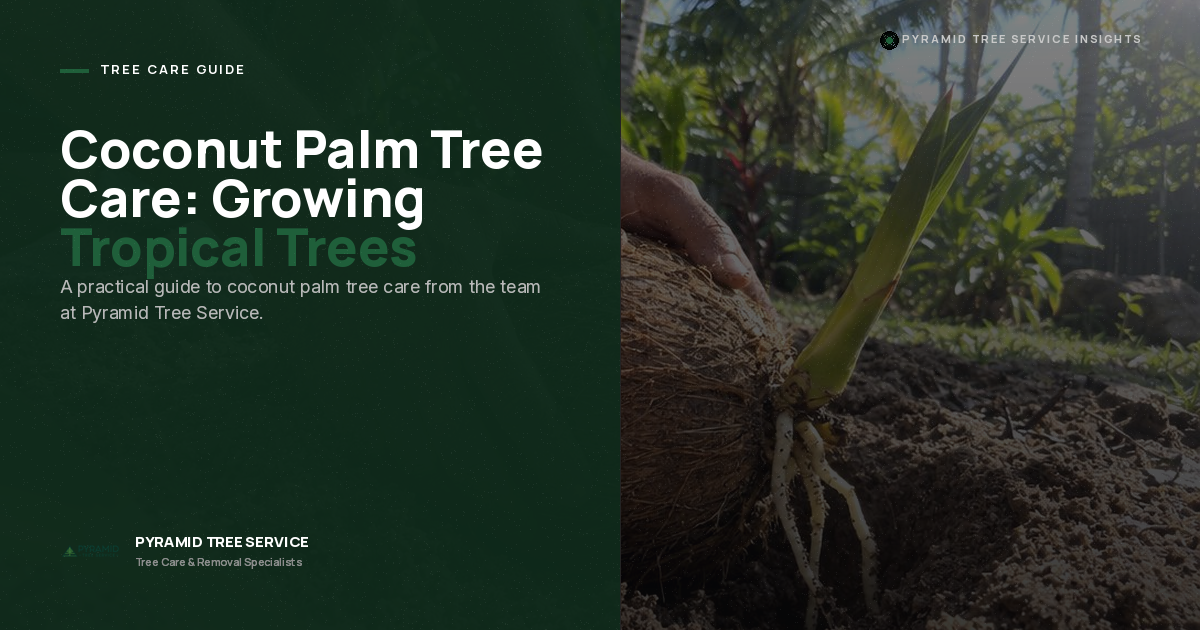
Coconut Palm Tree Care: Growing and Maintaining Tropical Trees
A coconut palm is the postcard version of the tropics, so people are often surprised at how particular it is to grow. Successful coconut palm tree care is less about a green thumb and more about honesty: the tree will thrive where it belongs and sulk, or simply die, where it does not. Here is the straight version, from a crew that climbs and prunes palms for a living.
- Coconut palms need a frost-free, humid climate (roughly USDA zone 10b and warmer). Cold is the number one reason home growers fail.
- Start with a mature whole coconut in its husk that still contains water. It does not need to be sprouted before planting.
- Coconut palms need regular nutrition and reliable moisture while establishing. Sandy, fast-draining soil suits them well, and they tolerate coastal salt exposure without requiring salty soil.
- Nutrient deficiencies are common in coconut palms and can resemble disease symptoms, so the location and pattern of discoloration matter.
- A tall, fruiting palm needs professional trimming. Falling fronds and coconuts are a real hazard.
Why Coconut Palms Are Harder to Grow Than People Expect
The honest answer to “why doesn’t everyone grow one?” is climate. A coconut palm (Cocos nucifera) is a true tropical plant with essentially no tolerance for cold. Temperatures in the low 30s Fahrenheit will damage the fronds, and a hard freeze will kill even a mature tree. That rules out almost the entire continental United States except the southern tip of Florida, Hawaii, and a handful of frost-free coastal pockets.
Here in the Memphis area, for example, winter lows settle this question for us. Our customers who love the palm look grow cold-hardy species like windmill, needle, or sabal palms instead, which shrug off a Tennessee winter. A coconut planted here would be a one-season novelty at best. If you are in a genuine tropical zone, though, the payoff is real, and the care is very learnable.
The second reason people struggle is a simple starting mistake: treating a coconut like an avocado pit. Coconut palms are propagated from the mature whole coconut, with the husk intact, rather than by removing and planting an inner pit. The coconut can germinate after it is placed in warm, moist growing media.

What Coconut Palm Tree Care Actually Requires
Once the climate box is checked, the day-to-day is refreshingly logical. Good coconut palm tree care comes down to five things done consistently: the right spot, the right planting method, steady water, generous feeding, and safe trimming as the tree gets tall.
Climate and location
Give it full sun, all day if you can. Coconut palms also want warmth and humidity, and they genuinely enjoy salt spray and sandy ground, which is why they line beaches. Plant well away from the house and power lines: a healthy tree can reach 60 to 80 feet, and you do not want a heavy coconut dropping onto a roof or a car.
Planting the nut
Start with a fresh coconut that still sloshes with water when you shake it. Lay it on its side in a pot of sandy, fast-draining mix, bury it about two-thirds deep, leaving roughly one-third above the growing medium, and keep it warm and moist. Sprouting takes three to six months, so patience is part of the job. Once a strong shoot and roots appear, move it to its permanent sunny spot.
Watering
Young palms want consistently moist soil, so water deeply a few times a week in the heat. Good drainage remains important, particularly for young palms, although coconut palms can tolerate periods of flooding. Avoid keeping the root zone chronically waterlogged. Sandy soil makes moisture management easier. Established palms are far more drought-tolerant but produce more and better fruit with regular moisture.
Feeding
This is where most growers fall short. Coconut palms are hungry, and the sandy soils they love hold very few nutrients. Use a slow-release “palm special” fertilizer with potassium and magnesium, plus manganese and boron, three or four times during the growing season. Skip the feeding and the tree tells on you fast, which brings us to problems.

Common Coconut Palm Problems and How to Read Them
The good news: most of what goes wrong with a coconut palm is a nutrient story, and the fronds spell it out if you know the alphabet. Before you reach for a fungicide, check the feeding first.
| What you see | Likely cause | The fix |
|---|---|---|
| Yellowing on the oldest, lowest fronds | Potassium or magnesium deficiency | Switch to a palm-specific fertilizer and feed on schedule |
| New growth crinkled or “frizzled” | Manganese deficiency (frizzle top) | Apply a manganese supplement promptly before the bud is lost |
| Browning frond tips, stalled growth | Cold damage or salt buildup from under-watering | Protect from cold; water deeply to flush salts through sandy soil |
| Oozing trunk, wilting crown | Possible lethal yellowing or bud rot (serious) | Call an arborist quickly; some conditions spread to nearby palms |
When several palms decline together, or the central spear pulls out easily, stop guessing and get a professional diagnosis.
Pruning and Safety as the Palm Gets Tall
Coconut palms do not need much pruning, and over-pruning actually harms them. Resist the urge to “hurricane cut” a palm into a few top fronds. Each green frond feeds the tree, and stripping them weakens the trunk and invites deficiency. The rule is simple: remove only fronds that are fully brown and dead, plus spent flower stalks and any low-hanging nuts over walkways.
The catch is height and weight. A mature coconut palm puts its dead fronds and heavy nuts 40, 60, even 80 feet in the air, directly above whatever is below. That is not a ladder job. Our certified arborists climb or use a lift, take weight off in controlled pieces, and clear everything away, the same way we handle our professional palm tree trimming services for the hardy palms around the Mid-South. If you have inherited a towering palm and are not sure where to start, that is exactly the kind of call we are glad to take.
Got a palm that has outgrown a ladder?
Free, no-obligation estimates across Memphis and North Mississippi.
How Long Until It Fruits, and Is It Worth It?
Patience is the last ingredient. Coconut palms can begin flowering after roughly four to six years, but the timing of fruit production and full productivity varies with cultivar and growing conditions. UF/IFAS notes that a palm may take much longer to reach full production. In a true tropical yard, it can be a rewarding tree once established. Outside that zone, it is a houseplant with an expiration date, and your effort is better spent on a palm built for your climate.
If tropical fruit trees are your thing, the same climate-first logic applies to other species. Our mango tree care guide walks through a similar warm-climate favorite, and our complete palm tree care guide covers the hardier palms most homeowners here can actually grow. For everything from planting advice to safe removals, our comprehensive tree care services start with a free on-site estimate.
For region-specific planting rules and the latest on palm diseases, the University of Florida IFAS Extension is an excellent, unbiased reference worth bookmarking before you plant.
Frequently Asked Questions
Can I grow a coconut palm from a grocery-store coconut?
Usually not. Most store coconuts have had the husk removed and are too old or dried out to sprout. You need a fresh, whole coconut in its husk that still has water sloshing inside. Specialty nurseries and tropical growers are your best source.
How cold is too cold for a coconut palm?
Fronds start suffering in the low 30s Fahrenheit, and a hard freeze can kill the tree outright. Coconut palms really only thrive in USDA zone 10b and warmer, which is why they are rare outside South Florida, Hawaii, and similar frost-free areas.
Why are my palm’s fronds turning yellow?
On a coconut palm, yellowing usually points to a potassium or magnesium shortage rather than a disease, especially in sandy soil. A proper palm-special fertilizer, used on schedule, resolves most cases. If new growth is distorted or the crown is collapsing, have it looked at professionally.
Is it safe to trim a tall palm myself?
We strongly advise against it once a palm is beyond ladder height. Falling fronds and coconuts are heavy, and working overhead near a trunk is how serious injuries happen. A licensed, insured crew with climbing gear or a lift is the safe way to handle it.
Palm Care Questions? Ask the Crew That Climbs Them.
Whether you are shaping a hardy palm, clearing dead fronds, or dealing with a hazardous tree, our certified arborists give straight answers and a free estimate, with no surprises when the truck pulls out of your driveway.