
Professional Landscaping: A Smart Guide to Trees as Design Elements
Most landscaping advice starts with flower beds, mulch, and lawn care. Those matter, but trees are what give a yard structure, shade, privacy, and long-term curb appeal. In professional landscaping, trees are not background plants. They frame the house, set the scale, create outdoor rooms, and help the rest of the yard feel intentional instead of scattered.
- Trees are the bones of a yard: they set scale, frame the house, and create shade.
- Good landscaping starts with placement, not just planting.
- Mature, healthy trees can improve curb appeal and support property value when they are well placed and maintained.
- Pruning and long-term care protect the investment far better than a one-time planting ever could.
Why Trees Are the Backbone of Good Landscaping
Walk through any neighborhood in Memphis that feels established and inviting, and the difference almost always comes down to the trees. A bare new-build lot and a 30-year-old lot can have identical houses, identical brick, identical square footage. The one with a pair of mature willow oaks out front looks finished. The bare one looks like it is still waiting on something. That something is vertical structure, and only trees provide it at that scale.
Everything else in a yard works in two dimensions, more or less flat against the ground. Trees are the one element that builds upward and overhead. They create a ceiling over a patio, a wall along a property line, and a frame around the front door. Good landscaping uses that on purpose. We think of a canopy the same way an interior designer thinks of a high ceiling: it changes how every other part of the space feels.
This is also why ripping out a healthy tree is rarely the first answer. We get calls every week from homeowners convinced a tree is in the way, when really it just needs shaping. Removing a focal-point tree can take a decade off the perceived maturity of a yard. When a tree truly is a hazard, our tree trimming and removal team handles it, but we will always tell you honestly whether shaping would serve the design better than cutting.
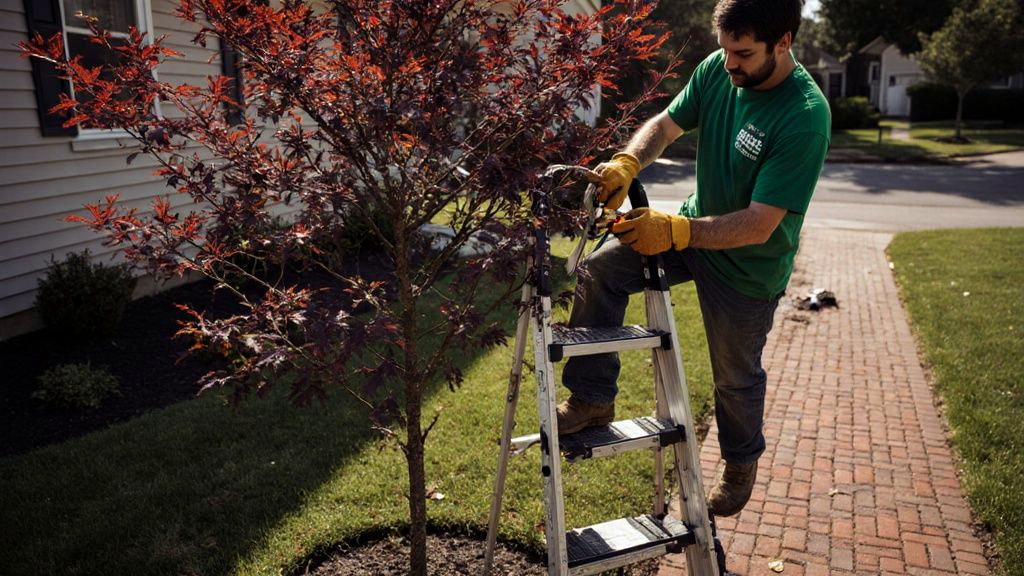
Crown-thinning a focal-point Japanese maple so light filters through instead of bouncing off a solid blob of leaves.
Placing Trees as Design Elements, Not Just Plants
The skill in landscaping is not just getting a tree into the ground. It is choosing the right species and putting it where it can do several jobs at once.
Anyone can dig a hole. Good design asks better questions:
- What will this tree look like at full size?
- Will the canopy frame the house or hide it?
- Will the roots, limbs, or trunk create problems later?
- Will it shade the right part of the yard?
- Will it work with the soil, drainage, and sun exposure?
A large shade tree near the west or southwest side of a home can help reduce afternoon heat, but the exact distance from the house should depend on mature canopy spread, root zone, roof clearance, underground utilities, and soil conditions. That matters because a tree that looks small today may be fighting the gutters, roofline, or driveway ten years from now.
Framing the house
Large trees belong at the corners of a lot or flanking the entry, never dead-center blocking the front of the home. Framing draws the eye to the house; planting in the middle hides it.
Creating a focal point
A single ornamental like a Japanese maple, redbud, or dogwood near the front walk gives the eye somewhere to land. One specimen tree, placed well, does more than a dozen shrubs.
Layering for depth
Tall shade trees in back, mid-size ornamentals in the middle, shrubs and beds in front. That stair-step of heights is what makes a yard read as designed rather than scattered.
Working with the sun
A deciduous tree on the west or southwest side shades the house in summer, then drops its leaves to let winter sun through. Smart placement lowers your cooling bill as a bonus.
Scale is the part homeowners miss most often. That three-gallon crepe myrtle from the garden center looks tiny next to a two-story house today, and that is exactly the problem: in eight years it may be crowding the eaves. Professional landscaping plans for the mature size, not the nursery-pot size. Picturing the tree at full height is the difference between a frame and a fight with your gutters.
Planning a yard around your trees?
Free, no-obligation estimates across Memphis & North MS.
How Trees Add Long-Term Property Value
This is where landscaping stops being decoration and starts being an investment. Mature, well-placed trees are one of the few yard features that appreciate instead of wearing out. A new fence loses value the day it goes up. A healthy oak is worth more every year it grows. According to the Arbor Day Foundation, mature trees and a thoughtfully planted yard can raise a property’s value by a noticeable margin and help homes sell faster.
The catch is that the value comes from health and placement, not just from having trees. A storm-damaged tree leaning over the roof subtracts value; buyers and inspectors see a liability. A balanced, well-pruned canopy that frames the home adds it. That gap is exactly what good landscaping and ongoing care are protecting.
| Role in the yard | Good tree choices | What it does for the design |
|---|---|---|
| Shade / framing | Willow oak, red maple, sycamore | Sets the scale, frames the roofline, cools the house |
| Focal point | Japanese maple, dogwood, redbud | Anchors the entry or front walk, adds seasonal color |
| Screening / privacy | Eastern red cedar, holly, Leyland | Forms a living wall along property lines |
| Accent / mid-layer | Crepe myrtle, serviceberry | Bridges the gap between shade trees and shrubs |
Species that perform well in the Memphis and North Mississippi climate. We confirm the right fit for your soil and sun at the estimate.
The Care That Protects Your Landscaping Investment
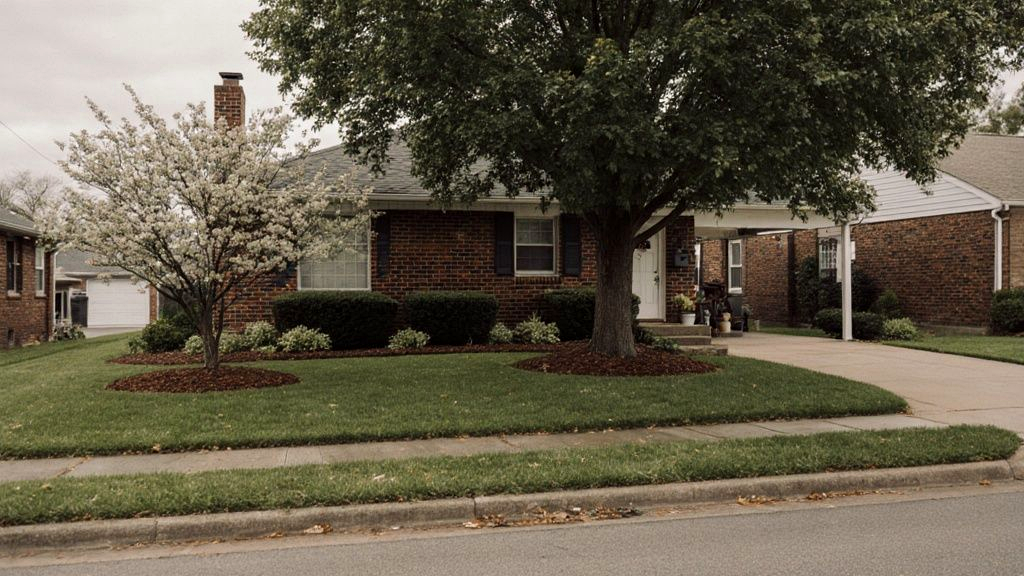
Layered heights, tall in back, ornamental in the middle, beds in front, are what make a yard read as designed.
A tree is the only design element in your yard that keeps growing after the crew leaves. That is why it needs ongoing attention to stay an asset. Skip care for a few years and a beautifully placed tree can become lopsided, crowded, or hazardous. This is the part of landscaping most DIY plans forget.
Young trees benefit from structural pruning because early shaping can prevent bigger correction work later. Mature trees may need crown thinning, canopy raising, deadwood removal, or selective pruning to improve clearance, light, and overall appearance.
Placement gets the design started. Care keeps the value in the ground. Mulch also matters. A wide, shallow mulch ring can help protect roots and reduce mower damage, but mulch should not be piled against the trunk. “Volcano mulching” traps moisture against the bark and can create decay and pest problems.
For larger landscape updates, Pyramid Tree Service provides professional landscaping services that can include design, planting, trimming, and long-term maintenance. When a stump is left behind, our stump grinding crew clears the way for whatever comes next.
Serving Memphis & North Mississippi
We design, plant, and maintain landscapes throughout the Memphis metro and across North Mississippi: Olive Branch, Southaven, Hernando, Horn Lake, and the surrounding communities. Free estimates, fully licensed and insured, with 20+ years of local experience.
Build the Yard Around the Right Trees
Before adding more mulch, shrubs, or flower beds, look at the trees first. Ask what should stay, what needs shaping, what is creating risk, and where a new tree could improve shade, privacy, or curb appeal.
For homeowners in Memphis and North Mississippi, the next step is a property walk-through. Pyramid Tree Service can help decide whether your yard needs pruning, new planting, stump grinding, or a more complete landscaping plan.
Start with the trees. The rest of the yard will make more sense after that.
Frequently Asked Questions
Where should I plant a shade tree so it does not damage my house?
As a rule of thumb, keep large shade trees at least 15 to 20 feet from the foundation, and farther for the biggest species. The goal is to enjoy the shade and framing without roots reaching the foundation or limbs threatening the roof. We map out safe placement as part of any landscaping plan.
Do trees really add to my home’s value, or is that just marketing?
It is real, with a condition: the value comes from healthy, well-placed, well-maintained trees. A mature canopy that frames the home and offers shade is a genuine selling point. A neglected or hazardous tree does the opposite. That is why care matters as much as the original planting.
Can you work trees into a yard that is already landscaped?
Absolutely, and it is some of our favorite work. Often the existing trees just need shaping or a smarter layout around them rather than a full redo. We look at what is already there, keep what is working, and add or prune to bring the whole design together.
How often should established trees be pruned?
For most mature trees in our area, a light structural pruning every three to five years is plenty, with deadwood removed as needed. Young trees benefit from more frequent shaping early on to set good structure. We will give you a simple schedule based on the species in your yard.
Let’s build your yard around great trees.
From placement and planting to pruning and cleanup, we handle the landscaping that makes a property look finished and hold its value for years. Free estimate, no pressure.