Arborist and Tree Removal: A Smart, Complete Guide to Choosing the Right Expert
If you have ever stood in your backyard staring up at a big, troubled oak and wondered who to call, you are asking exactly the right question. Arboriculture covers tree assessment, pruning, plant health care, risk management and removal, but not every tree service offers the same expertise. Hiring a contractor without the right assessment skills can cost you money or, worse, a healthy tree you could have kept.
Homeowners around Memphis often assume an arborist and a tree removal professional perform completely separate jobs, and it is easy to see why. Both may involve climbers, chainsaws and trucks in the driveway, but the appropriate service depends on the tree’s condition and the risks around it. Some companies focus mainly on removal, while others employ credentialed arborists who can assess whether pruning, treatment, monitoring or removal is the most appropriate option.
- An arborist is trained in tree health, structure and care, while tree removal is a specialised service that many arborists and tree-care companies provide.
- Call an arborist when a tree might be saved, is valuable, or needs a real diagnosis.
- Removal may be appropriate when a tree is dead, presents an unacceptable risk or cannot remain in its location.
- The best first step is almost always a professional assessment, not a chainsaw.
What a Certified Arborist Actually Does
Think of a certified arborist as a doctor for trees. Where a general crew looks at a tree and asks “how do we cut this down,” an arborist looks at the same tree and asks “what is wrong with it, and can we fix it.” That difference in mindset is the whole point.
A qualified arborist earns credentials through the International Society of Arboriculture, which tests real knowledge of tree biology, diagnosis, and safe work practices.
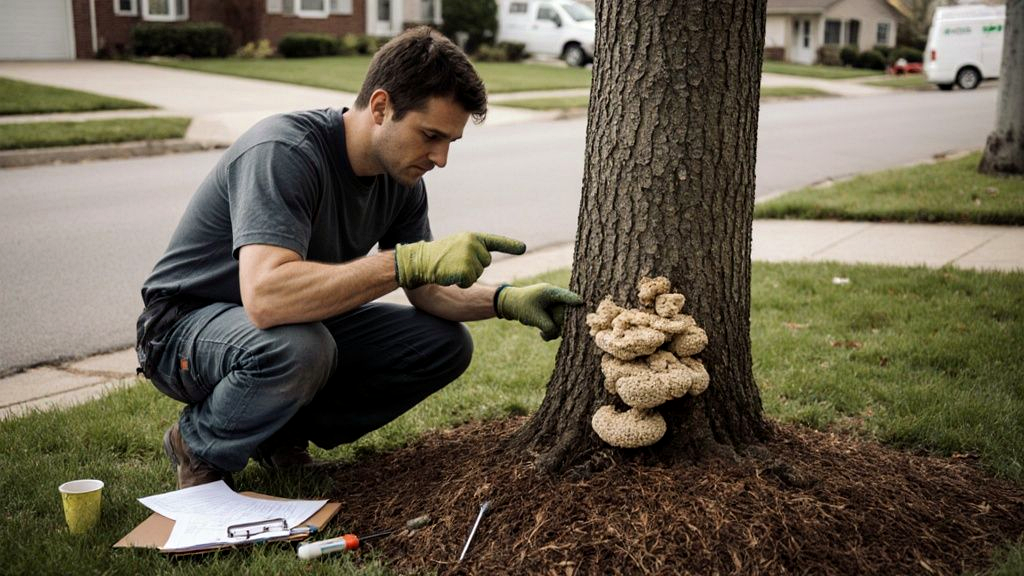
That training shows up in day-to-day work. An arborist may read the canopy for early signs of disease, assess fungal fruiting bodies and decay symptoms around the root flare, identify structural weaknesses and determine when strategic pruning could address a problem that a homeowner assumed required removal. Additional testing may be recommended when the exact cause of a condition cannot be confirmed visually.
The services an arborist provides are mostly about keeping trees healthy, managing risks and determining when removal is necessary:
- Diagnosis and health assessment for a tree that is dropping leaves early, oozing sap, or thinning at the top.
- Corrective and structural pruning that removes hazards while preserving the tree’s long-term shape and health.
- Cabling and bracing that may provide additional support for selected weak branches or stems. These systems do not eliminate the possibility of failure and require professional inspection and maintenance.
- Pest and disease management for the issues that are common in the Mid-South, from borers to root rot.
- Risk assessment that tells you, honestly, whether a tree is a real threat or just an eyesore.
As a certified arborist company serving the Memphis metro, our first instinct on most calls is to figure out whether a tree can be saved. A mature shade tree adds real value to your property, and a good trim is a lot cheaper than a full removal plus years of waiting for a replacement to grow back.
What a Professional Tree Removal Service Does
Tree removal is a specialised part of professional tree care. It may be recommended when a tree is dead, structurally unstable, creating an unacceptable level of risk or standing in a location where it cannot reasonably remain, such as directly over a building or interfering with planned construction.
Removing a large tree safely is a serious, physical, high-skill job. A trunk that looks manageable from the ground can weigh several tons, and where those tons fall is not something you leave to chance. When a tree stands close to a house, a fence, or utility lines, our crews take it down in controlled sections using ropes and rigging rather than felling it in one piece. Each cut piece gets lowered deliberately, not dropped.
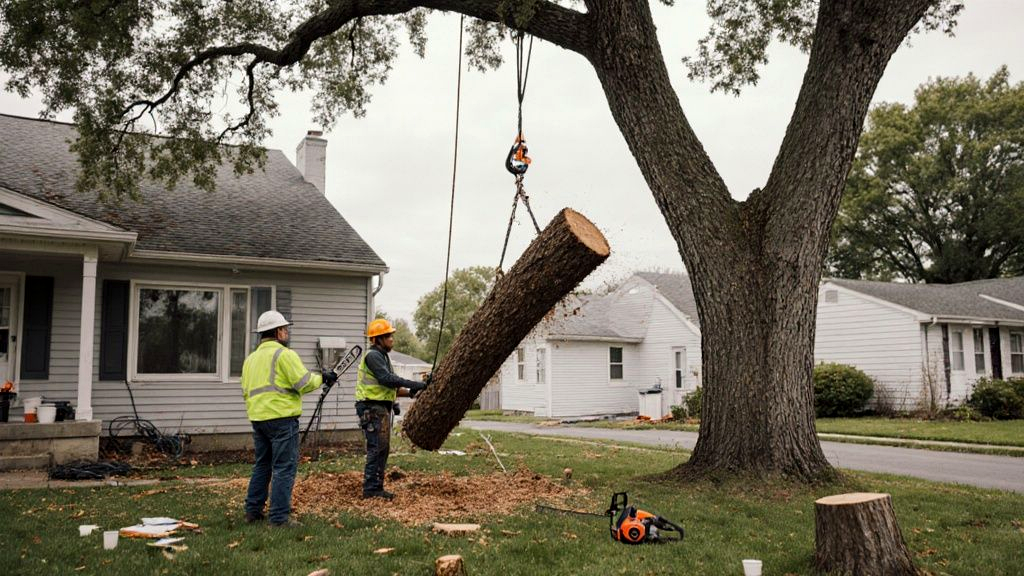
Our professional tree removal services cover the full job, not just the felling: the takedown, hauling off the wood and brush, and grinding the stump if you want the spot cleared for grass or a new planting. When a storm drops a limb on a roof at midnight, that same skill set becomes emergency work, which is why removal crews carry cranes, chippers, and around-the-clock dispatch. A removal specialist is measured on doing a heavy, dangerous job cleanly and leaving your yard looking like nothing ever happened.
Arborist vs Tree Removal: The Real Difference
Rather than treating arborists and removal providers as competing professions, it is more useful to compare an assessment-led arboricultural service with a removal-focused contractor. Either provider may perform tree removal, but their credentials, assessment capabilities, insurance, safety procedures and equipment should be verified.
| Certified Arborist | Tree Removal Service | |
|---|---|---|
| Main goal | Keep the tree healthy and standing | Take the tree down safely |
| Typical work | Diagnosis, pruning, cabling, treatment | Rigging, sectioning, felling, cleanup |
| Best for | Valuable or salvageable trees | Dead, hazardous, or misplaced trees |
| Outcome for the tree | Preserved and improved | Removed and hauled away |
| You call when | You are not sure and want a real answer | You already know it has to go |
Here is the catch that trips people up: you often cannot tell which one you need just by looking. A tree that looks doomed to a homeowner may be perfectly savable, and a tree that looks fine can be hollow inside. That uncertainty is exactly why the assessment matters more than the chainsaw.
Not sure which one your tree needs?
Free, no-obligation estimates across Memphis and North Mississippi.
When Arborist and Tree Removal Work Together
In real life, tree assessment and removal are not rival services. Some full-service tree-care companies provide both, while other removal contractors coordinate with independent arborists or specialists. What matters is that the recommendation is based on the tree’s condition, surrounding targets and available risk-management options rather than an automatic assumption that removal is required.
A typical job flows in that order. Someone calls worried about a leaning maple. An arborist looks first: checks the root flare, sounds the trunk for hollow spots, weighs the lean against the soil condition. Sometimes the verdict is good news and a targeted prune solves it. Sometimes the tree is past saving, and then the removal crew takes over with the rigging and the cleanup. Same company, one visit, two skill sets. Our complete tree and stump removal process is built around exactly that handoff.
A full-service company can coordinate assessment, pruning and removal through one provider, although complex or hazardous work may require separate visits, specialist equipment, permits, utility coordination or additional planning. Our complete tree and stump removal process is built around that coordinated approach.
How to Choose the Right Pro for Your Tree
You do not need to be an expert to make a smart first call. You just need to recognise a few signals. Start with an arborist or another appropriately qualified tree-care professional when the condition is uncertain, and seek a removal quote after the tree has been assessed or when it is clearly dead and creating an immediate hazard.
Start with an arborist if
The tree is mature and valuable, it is thinning or dropping leaves oddly, part of it is alive and part is not, or you honestly just do not know how bad it is. A diagnosis protects a tree worth keeping.
Get a removal quote if
The tree is clearly dead, a major trunk crack has already opened, it is leaning hard after a storm, or it is growing straight into your house or the power lines. At that point the question is how, not whether.
Whichever way you lean, hire someone who is licensed and insured and who can explain the reasoning, not just quote a number. The insurance piece is not a formality either. If a tree is genuinely hazardous, how the work is documented can matter to a future homeowners claim, and that is one more reason a knowledgeable crew is worth more than the cheapest bid.
When you are still on the fence, get the assessment. It costs nothing, it takes about twenty minutes, and you walk away knowing whether you are looking at a quick trim or a full removal. If you want a sense of the process before you call, our guide on what to expect from a tree removal service walks through each step.
Frequently Asked Questions
Is an arborist more expensive than a tree removal service?
Not necessarily, and often the opposite. Arborist work like a corrective prune is usually cheaper than a full removal because it is less labor and no hauling of a whole tree. Paying for a diagnosis first can actually save you the much larger cost of removing a tree that did not need to go.
Can one company do both the arborist work and the removal?
Yes, and that is usually the ideal setup. A full-service crew can assess the tree, save it if it is salvageable, and remove it safely if it is not, all in one visit. You get one point of contact and an honest recommendation rather than a hard sell in either direction.
How do I know if my tree can be saved or has to come down?
The reliable way is a professional assessment. A trained eye checks the living-to-dead ratio in the canopy, looks for trunk cracks and decay, and evaluates the root zone. A tree that is more than about half dead, badly cracked, or rotting at the base is usually a removal. Most others have options.
Do you serve areas outside Memphis?
Yes. We work throughout the Memphis metro and across North Mississippi, including Olive Branch, Southaven, Hernando, and Horn Lake. Estimates are always free, and we are fully licensed and insured for both pruning and heavy removal work.
Still deciding? Let us take a look.
Whether your tree needs a careful hand or a clean removal, the smart first move is the same: a free, no-pressure assessment from a crew that does both and tells you the truth.