

The Complete Mango Tree Care Guide for Healthy, Fruitful Growth
A mango tree is one of the most satisfying plants you can grow, and it is also one of the most misunderstood. Get a few things right early and it rewards you for decades. Get them wrong and it sulks, drops its flowers, or never fruits at all. This guide walks through the mango tree care that actually moves the needle: where to plant, how to water and feed, when to prune, how to head off disease, and what it takes to keep one alive here in the Mid-South, where winter is the real enemy.
- Full sun, sharp drainage, and patience matter more than any fertilizer.
- Mangoes hate wet feet: overwatering kills far more trees than drought.
- Light structural pruning after harvest gives you air, light, and better fruit.
- Anthracnose is one of the most serious mango diseases in humid growing regions. Prevent it, do not chase it.
- In the Memphis area, a mango is a container plant that overwinters indoors.
Mango Tree Care Starts With the Right Spot
Almost every mango problem traces back to location. These are tropical trees that evolved in hot, bright, well-drained ground, and they do not compromise on any of the three. Before you think about pruning shears or feeding schedules, get the placement right, because moving a mango later is a shock it does not always survive.
Sun. A mango wants a minimum of six to eight hours of direct light, and more is better. Shade produces a leggy tree with thin foliage and almost no fruit. If you are growing in a pot, that means the sunniest corner of the yard in summer and the brightest south-facing window you have in winter.
Soil and drainage. This is the part people skip. Mango roots rot in soggy ground, so the soil has to drain fast. In a container, use a coarse, chunky mix cut with plenty of perlite or pine bark rather than a dense water-holding potting soil. In the ground, plant on a slight mound so water never pools at the trunk. If you dig a hole and it still holds water an hour later, that spot will eventually drown the tree.
Space. A grafted dwarf variety like Cogshall or Pickering stays manageable at eight to twelve feet, which is why they are the smart pick for pots and small yards. Full-size seedling trees can top forty feet, so give them room away from the house, the roof, and any power lines.
Watering and Feeding a Young Mango Tree
Watering is where good intentions do the most damage. A new mango wants consistent moisture while it establishes its roots, but a mature one is genuinely drought-tolerant and resents constant wet soil. The rhythm that works: water deeply, then let the top couple of inches dry out before you water again. Stick a finger in the soil. If it is damp, wait.
Container trees dry faster and need checking more often in summer heat, but the same rule applies. Yellowing leaves and a soft, sour smell at the base almost always mean too much water, not too little. This is the single most common mistake we see in mango tree care, and it is the one most likely to be fatal.
Feeding is simpler than the internet makes it sound. During the growing season, from spring through late summer, a young tree does well on a balanced fertilizer with micronutrients, applied lightly and often rather than in one heavy dose. Mangoes are hungry for the trace minerals, especially iron, zinc, and manganese, so a product formulated for fruit trees or palms beats a generic lawn feed. Ease off entirely in fall and winter so you are not pushing tender new growth into the cold.
One quiet rule that changes everything
Do not fertilize a stressed or bone-dry tree. Water it thoroughly first, let it recover for a day, then feed. Fertilizer salts hitting dry roots will scorch them and set the tree back weeks.
Proper Pruning Techniques for Better Fruit
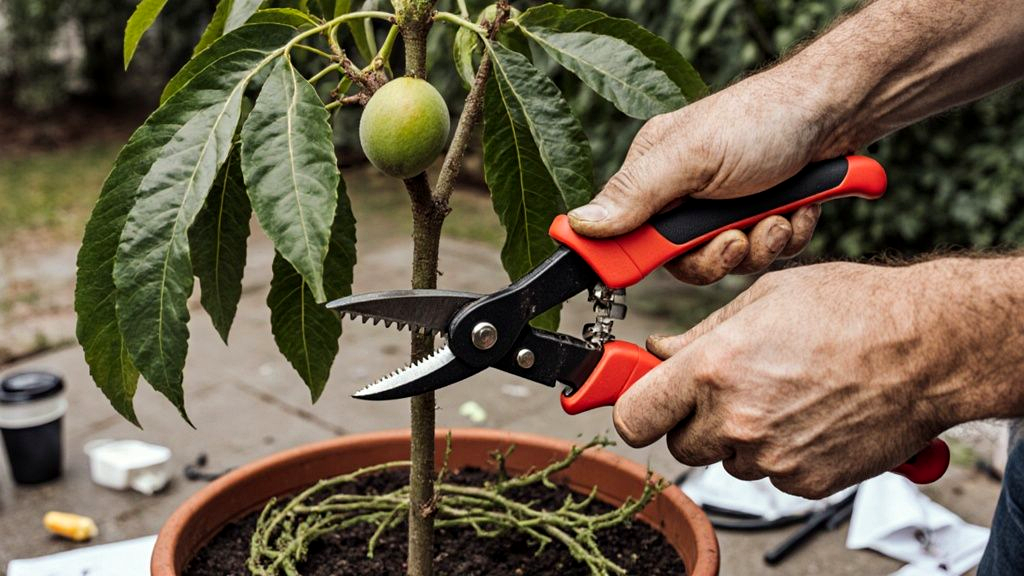
Mangoes fruit best on an open, well-lit canopy, and that only happens if you shape the tree while it is young. The goal is not to shrink it every year. The goal is to build a strong frame of a few well-spaced main branches, then keep the middle open so sunlight and air reach the interior. Dense shade reduces flowering, limits airflow, and can increase disease pressure inside the canopy.
For fruiting mangoes, time light pruning for right after harvest, ideally within a month of the last fruit, so you do not remove next season’s flowering wood. For container-grown mangoes in colder climates like Memphis, limit winter pruning to dead, damaged, crossing, or problem growth.
Use clean, sharp bypass pruners or a saw for anything thicker than your thumb, and make each cut just above an outward-facing bud so the new growth heads away from the center. Take out anything dead, crossing, or growing straight up through the middle. These are the same proper pruning techniques we use on fruit and shade trees every week, scaled down for a smaller tropical tree.
Resist the urge to over-prune. Removing more than about a third of the canopy in a single season stresses the tree and can cost you a year of fruit. If you have grown fruit trees before, the logic will feel familiar. Our walkthrough on apple tree pruning covers the same open-center principle for temperate orchards, and mangoes reward the exact same restraint.
Preventing the Diseases That Threaten Mango Trees
Mangoes are tough, but a handful of fungal problems can wreck a crop, and prevention beats treatment every time. One of the most serious is anthracnose, especially in humid regions and wet bloom periods. It shows up as dark, sunken black spots on leaves, and worse, as blackened, shriveled flower panicles that drop before they ever set fruit. Humid springs, exactly what we get around Memphis, are its favorite weather.
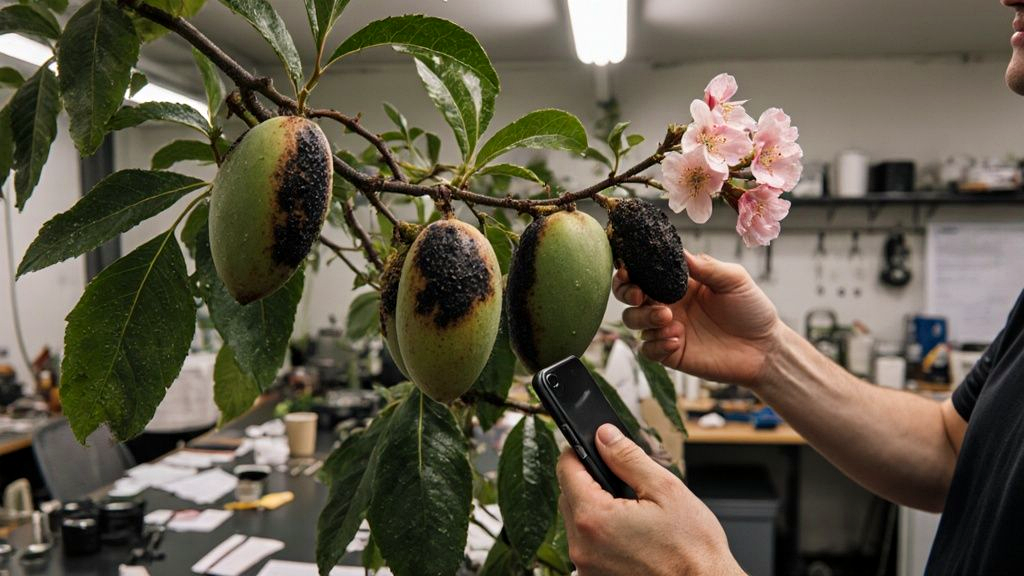
The best defense is cultural, not chemical. Keep the canopy open so foliage dries quickly after rain, water at the base instead of overhead, and rake up fallen leaves and mummified fruit where spores overwinter. Powdery mildew, a white dusty film on new growth and flowers, responds to the same airflow-first approach. If pressure is heavy in a wet year, a copper-based fungicide applied as the flower panicles emerge can protect the bloom, but a tree grown in good light with clean housekeeping rarely needs much.
If disease pressure is heavy in a wet year, a properly timed copper-based fungicide as flower panicles emerge may help protect the bloom. In a home setting, disease control is usually not intensive, but any fungicide use should follow local extension guidance and the product label.
Watch the trunk and roots too. Soft bark, oozing sap, or that sour smell we mentioned earlier points to root or collar rot, which almost always circles back to drainage. In tropical care, healthy roots are the whole game, and no spray fixes a tree that is standing in water.
Growing Mango Trees in the Mid-South Climate
Here is the honest part. Mangoes are hardy only in the warmest corners of the country, roughly USDA zones 10 and 11, and Memphis sits well outside that. A mature mango is damaged by temperatures in the low 30s and a hard freeze will kill an unprotected tree outright. You can confirm your own zone on the USDA Plant Hardiness Zone Map, but for the Mid-South the takeaway is simple: outdoors and in the ground is not an option.
The workaround that actually works is a container. Plant a dwarf variety in a large, well-drained pot on a rolling caddy, keep it outside in full sun from the last spring frost through early fall, then roll it into a bright, heated space, a sunroom, a garage window, or the sunniest room in the house, before the first cold snap. It is the same overwintering routine our local Meyer lemon growers use to keep tender citrus alive through a Tennessee winter, and mango responds to it just as well.
Indoors, give it the brightest window you have and cut watering back sharply, since a cool, dim tree uses very little. Do not fertilize over winter. Come spring, harden it back off to outdoor light gradually over a week or two so the leaves do not scorch. It is more work than a shade tree, but a potted mango on a Memphis patio is absolutely doable with the right habits.
Your Mango Tree Care Calendar
Most of mango tree care comes down to doing the right task in the right season. Here is the year at a glance for a container-grown tree in our climate.
| Season | Main tasks | Watch for |
|---|---|---|
| Spring | Move outdoors after last frost, resume feeding, watch flowering | Anthracnose on blooms, sudden late cold snaps |
| Summer | Full sun, deep but infrequent watering, light feeding | Dry containers, spider mites in heat |
| Fall | Harvest, structural pruning, taper off fertilizer | First frost date, moving tree before cold |
| Winter | Indoors in bright light, minimal water, no feeding | Leaf drop from low light, cold drafts near windows |
A container mango’s whole year hinges on two dates: last spring frost and first fall frost. Everything else follows from those.
Have a bigger tree that needs a pro?
Free, no-obligation estimates across Memphis & North Mississippi.
When to Call an Arborist
A potted mango is a project you can handle yourself. The trees on the rest of your property are a different story. When a shade tree gets too large to prune safely from the ground, leans after a storm, or grows into a roofline or power line, that is the point to bring in help rather than a ladder and a hope. The same open-canopy and disease-prevention thinking in this guide scales up, but the risk scales up faster.
That is what our team does across the Memphis metro and North Mississippi. If you want a hand with the big trees while you fuss over the mango on the patio, our professional tree care services cover trimming, removal, stump grinding, and storm cleanup, all fully licensed and insured.
Frequently Asked Questions
How long until a mango tree produces fruit?
A grafted tree, which is what you should buy, often fruits within three to five years. A tree grown from a grocery-store seed can take eight years or more and may not come true to the parent, so start with a named grafted variety if fruit is the goal.
Why does my mango tree flower but never set fruit?
Usually cool or wet weather during bloom, or anthracnose blackening the flowers before they set. Poor light and heavy pruning also suppress fruiting. Improve airflow, keep the foliage dry, and make sure the tree gets full sun, and the fruit set usually improves the next season.
Can I really grow a mango tree in Memphis?
Yes, but only in a container that overwinters indoors. Our winters are far too cold for a mango planted in the ground. Choose a dwarf variety, keep it on a rolling caddy, and bring it into a bright, heated space before the first frost each year.
What is the fastest way to kill a mango tree?
Overwatering and poor drainage, by a wide margin. Mango roots need air. A pot with no drainage holes or a dense, water-holding soil will rot the roots quietly until the tree collapses. When in doubt, water less and drain more.
Growing tropical, thinking about your whole yard?
Whether it is a potted mango on the patio or a fifty-foot oak over the driveway, we are happy to take a look. Free estimates, honest advice, and a crew that climbs trees for a living.