
Apple Tree Pruning How To: Timing and Technique That Bring Back the Fruit
If your apple tree has become crowded, tangled, or slow to fruit, proper pruning can help improve its structure, sunlight exposure, airflow, and long-term health. This apple tree pruning how to guide explains when to prune, what to cut, what to leave alone, and when a backyard tree is better handled by a professional crew.
Around Memphis and North Mississippi, apple tree pruning questions usually come up in late winter, when homeowners notice a tree full of crossing limbs, upright shoots, dead wood, or branches growing too close to the roof. The good news is that apple tree pruning is not about cutting as much as possible. It is about making careful cuts that help the tree grow stronger and make better use of light.
- Prune apple trees while they are dormant: roughly late January through early March in our climate.
- The first job of every cut is removing dead, damaged, and diseased wood.
- Open up the center of the tree so sunlight and air reach the fruiting branches.
- Never take off more than about a quarter to a third of the canopy in a single year.
- When a tree is large, near power lines, or too far gone, bring in a professional.
When to Prune: Why Timing Decides Everything
Timing is the part many homeowners get wrong, and it matters more than any single cut. The best time to prune an apple tree is during the dormant season, after the coldest weather has passed but before buds begin to swell in spring. In the Memphis area, that usually means late January through early March.
Dormant pruning works for three main reasons. First, with the leaves gone, you can clearly see the structure of the tree. Dead limbs, crossing branches, crowded areas, and weak angles are much easier to spot. Second, the tree is not actively pushing new growth, so it loses less energy when you prune. Third, cuts made in late winter can begin closing once spring growth starts, which supports the kind of structure and light access that Virginia Tech Extension highlights in its apple tree pruning guidance.
Light summer pruning can still be useful. After the tree leafs out, you can remove suckers at the base, cut back water sprouts, and thin a small number of crowded interior shoots to help sunlight reach developing fruit. Keep summer pruning modest. Heavy cutting during hot weather can stress the tree and expose bark or fruit to sunscald.
Skip fall pruning. Cuts made in autumn heal slowly heading into winter, and the open wounds invite decay fungi and diseases like fire blight. If you missed your winter window, it is almost always better to wait than to prune in October.
| Time of year | What to do | Recommended? |
|---|---|---|
| Late winter (dormant) | Main structural pruning: dead wood, thinning, shaping | Best window |
| Early spring (pre-bud) | Finish any structural cuts before buds swell | Good |
| Summer (June to August) | Light only: suckers, water sprouts, opening light to fruit | Light only |
| Fall (September to November) | Wounds heal slowly, disease risk rises | Avoid |
Memphis and North Mississippi timing. Dates shift a week or two year to year, so watch the buds, not the calendar.
Apple Tree Pruning How To: A Step-By-Step Method
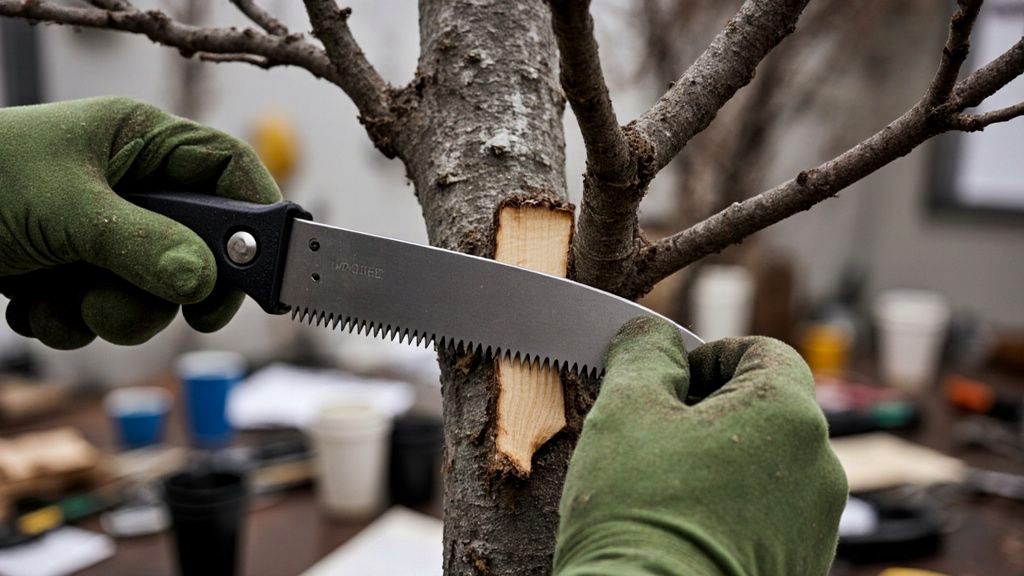
A clean cut sits just outside the swollen branch collar, never flush with the trunk.
Once the timing is right, the work itself follows a simple order. Move through these steps in sequence and you will rarely overcut, because each pass removes the most obvious problems before you start fine-tuning the shape.
Start with the three D’s
Remove every branch that is dead, damaged, or diseased first. This often clears a surprising amount of the canopy on a neglected tree and lets you see what you are actually working with before you make a single shaping cut.
Take out crossing and rubbing branches
Where two limbs cross and rub, the bark wears away and creates a wound that never heals. Pick the stronger, better-placed branch of the pair and remove the other one back to its origin.
Remove water sprouts and root suckers
Those skinny vertical shoots growing straight up from the limbs (water sprouts) and the ones at the base of the trunk (suckers) drain energy and rarely fruit. Cut them off cleanly at their base.
Thin the canopy to let light in
Apples need sunlight on the interior wood to set fruit. Open the center so a bird could fly through it. Aim to remove crowded inward-growing branches rather than just shortening the tips, which only makes the outside bushier.
Shape for structure
Keep well-spaced scaffold branches that spread outward and slightly upward, and favor a single dominant leader or an open vase shape. Head back the tallest growth so future fruit stays within reach instead of climbing out of a ladder’s range.
Step back, then clean up
Walk around the tree every few cuts to check your balance and avoid lopsided removal. When you finish, rake up and haul off the cuttings, especially any diseased wood, so it does not reinfect the tree.
Where you cut matters as much as what you cut. Make each cut just outside the branch collar, the slightly swollen ring of bark where the branch meets the trunk or a larger limb. That collar contains the tissue the tree uses to seal the wound, so cutting flush against the trunk removes it and leaves a wound that struggles to close. Leaving a long stub is the opposite mistake: the stub dies back and rots.
Tree too tall or tangled to tackle safely?
We offer free, no-obligation estimates across Memphis and North MS.
Common Apple Tree Pruning Mistakes to Avoid
Even after reading an apple tree pruning how to guide, it is easy to make mistakes if you cut too aggressively or prune in the wrong place. These are the biggest ones to avoid.
- Over-pruning. Avoid removing more than about one-quarter to one-third of the live canopy in one season because heavy pruning can stress the tree and trigger weak, upright regrowth. If the apple tree is badly overgrown, do not try to fix everything at once. Restore it gradually over two or three winters for healthier growth and better long-term structure.
- Topping the tree. Topping means cutting the upper crown back to large stubs, and it is one of the worst pruning mistakes for apple trees. It can lead to decay, weak regrowth, and a shorter tree lifespan. If the tree is too tall, use selective reduction cuts or hire a professional to prune it properly.
- Making flush cuts or leaving long stubs. A flush cut removes the branch collar and creates a larger wound than needed. A long stub leaves dead wood that can rot back into the tree. Make the cut just outside the branch collar so the branch is removed cleanly without damaging the trunk tissue.
- Pruning in wet conditions. Avoid pruning when the apple tree is wet, especially if disease is suspected. Fire blight and other diseases can spread more easily through damp tools, branches, and foliage. Use clean, sharp tools, disinfect them often, and cut infected limbs well below the visible symptoms.
- Using wound paint or tar. Avoid using wound paint, tar, or pruning sealers for routine apple tree pruning. These products can trap moisture and interfere with the tree’s natural wound closure. A clean, properly placed cut is usually enough, so let the tree heal on its own.
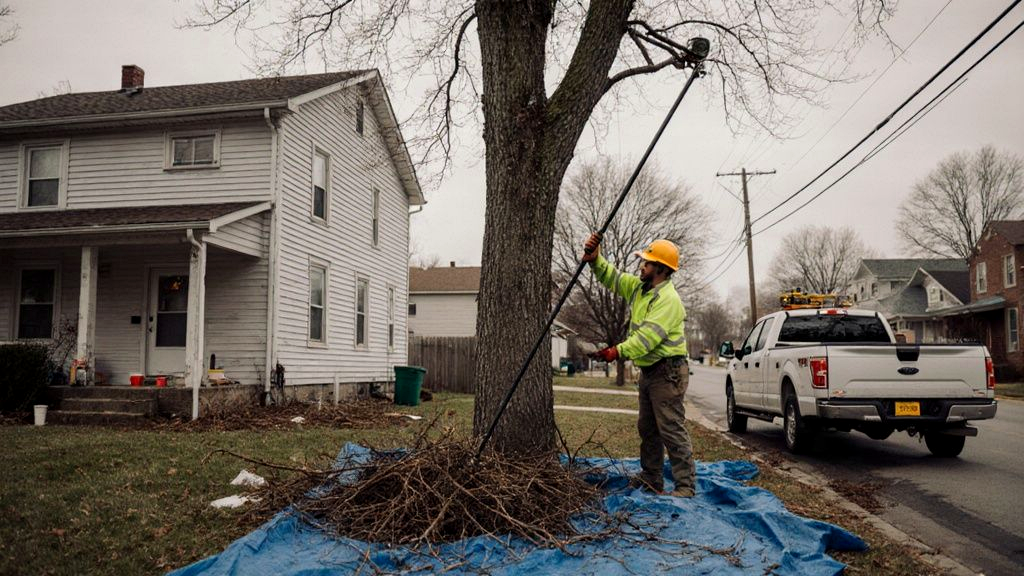
When the high limbs sit over a roof or near lines, a pole pruner and a trained crew are the safe call.
Tools, Safety, and When to Call the Pros
For a small backyard apple tree, you may only need a few basic tools:
- Bypass hand pruners for small shoots and branches
- Loppers for medium-sized branches
- A pruning saw for larger limbs
- A pole pruner for light cuts that are slightly out of reach
- Rubbing alcohol or disinfectant for tool sanitation
- Gloves and eye protection
Use bypass pruners for most live cuts because they make cleaner cuts and crush less tissue than anvil-style pruners. Keep tools sharp because dull blades can tear bark and make wounds harder for the tree to close. Small trees and ground-level cuts may be manageable, but tall trees, roofline branches, power lines, or chainsaw work from a ladder are not safe DIY jobs.
That is when it makes more sense to use professional help. Our team at Pyramid Tree Service provides tree trimming services in Memphis for homeowners who need safer pruning, crown thinning, limb removal, or structural trimming around homes and outdoor spaces.
If a storm has already broken a major limb or left a branch hanging over your roof, treat it as a safety issue rather than a weekend pruning project. We also offer emergency tree services for urgent tree hazards across the Memphis area.
Sometimes pruning is not the answer. If an apple tree is mostly dead, hollow at the base, badly split, or leaning toward a structure, removal may be safer than repeated pruning. In that case, review our tree removal services to understand when removal may be the better option.
Frequently Asked Questions
What is the best month to prune apple trees in the Memphis area?
Late winter, generally from late January through early March, while the tree is still dormant but the hardest freezes are behind us. Watch the buds: as soon as they start to swell, your window is closing and it is best to finish up.
How much of the tree can I safely remove in one year?
As a rule of thumb, no more than a quarter to a third of the live canopy in a single season. If a neglected tree needs more than that, spread the work across two or three winters so you do not shock it into a flush of weak, fruitless growth.
Should I paint or seal the pruning cuts?
No. Wound paints and tar were standard advice for decades, but research has shown they trap moisture and actually slow healing. A clean cut made just outside the branch collar seals best when you leave it open to the air.
My apple tree has not fruited in years. Will pruning fix it?
Often it helps a great deal. A crowded, shaded canopy is a common reason a mature tree stops fruiting, and opening it up to sunlight can restore production within a season or two. Pollination, variety, and soil also play a role, so a site visit is the surest way to know what is holding yours back.
Can I prune in summer instead of winter?
You can do light summer work: removing suckers, thinning a few interior branches, and pinching back vertical shoots to let sun onto the fruit. Save the heavy structural cuts for the dormant season, since major pruning in the heat stresses the tree and can scald exposed bark.
The tree is huge and near my house. Should I prune it myself?
If the work means climbing high, running a chainsaw overhead, or cutting near power lines or the roof, it is worth calling a professional. The risk of a fall or a misjudged limb is real, and a trained crew has the rigging and insurance to do it safely. We offer free estimates so you can weigh it out at no cost.
Want it pruned right the first time?
Whether your apple tree needs a careful winter trim or it is simply too big to handle from a ladder, our crew prunes for healthy growth and better fruit. Free estimates across Memphis and North Mississippi.