Landscaping Design Services: A Smart, Expert Guide to Integrating Trees Into Your Plan
A new flowerbed can be moved next spring. A poorly placed tree can become a thirty-year problem. That is why good landscaping design services should treat trees as the structural bones of the yard, not the final detail added after the patio, flowerbeds, and lawn are already planned.
Around Memphis, many yard problems start with a simple mistake: someone plants a tree where it looks good as a small nursery specimen, not where it will make sense once it reaches full size. Years later, that same tree may be crowding the roofline, lifting a walkway, blocking sight lines, dropping limbs over a driveway, or growing too close to utility lines.
This guide explains how to integrate trees into a landscape plan the right way, what mistakes cost homeowners the most, and when local landscaping design services can help you make better long-term decisions.
- Trees should be planned first, not squeezed into leftover spaces.
- Mature size matters more than nursery size.
- The right tree in the wrong place is still the wrong tree.
- Existing mature trees are valuable assets worth designing around.
- Before digging for new trees or shrubs, call 811 so buried utilities can be marked.
- Local tree and landscaping experience matters because Memphis soil, drainage, heat, and storm patterns affect what will actually work.
What Professional Landscaping Design Services Actually Do
Landscape design is not just picking plants from a catalog; that is the easy part. The real work is deciding what belongs where based on the house, drainage, sun exposure, property lines, utilities, existing trees, walkways, driveways, and how people actually use the yard. Good landscaping design services read the property first, then make recommendations that fit the space instead of forcing a generic plan onto it.
For tree-focused landscape planning, the biggest questions are practical:
Where will shade be useful in ten years?
Will the tree have enough room at full size?
Will roots conflict with a driveway, sidewalk, patio, or foundation?
Will branches eventually interfere with the roof, power lines, or visibility from the street?
Can the soil and drainage support that species?
This is where a local team matters. Pyramid Tree Service offers landscaping services in Memphis that include design, planting, lawn care, flowerbeds, trimming, and curb appeal improvements. That makes the service more grounded than a pretty drawing. The plan has to survive real Memphis weather, clay soil, summer heat, and years of growth.
Place the Trees First, Then Everything Else
Here is the principle we come back to on every job: design from the most permanent element outward. Trees are more permanent than your patio, your fence, even your driveway. A driveway can be torn out and re-poured in a weekend. A 60-foot oak took half a lifetime to get there. So trees get placed first.
That sequence flips how a lot of homeowners instinctively work. The temptation is to plan the fun, visible stuff first (the fire pit, the raised beds, the path) and slot trees into the leftover gaps. The result is almost always a tree crammed into a corner where it will outgrow the space, shade the vegetable garden you wanted in full sun, or send roots straight under the new walkway.
When you place the canopy trees first, the rest of the design organizes itself naturally. The shade they will cast tells you where to put the patio and where to put the sun-loving beds. Their eventual height tells you what stays clear of the power lines. Their trunk location, projected to mature spread, tells you how far the driveway needs to sit. The trees become the framework, and the smaller plantings, lighting, and hardscape fill in around a structure that will still make sense decades from now.
Planning a yard around new or existing trees?
Free, no-obligation estimates across Memphis & North MS.
Landscaping Design Services and the “Right Tree, Right Place” Rule
The most expensive landscaping mistakes usually come from one problem: the wrong tree in the wrong spot. Sometimes the species is fine, but the placement is bad. Sometimes the location is fine, but the tree will eventually get too large, too messy, too thirsty, or too close to hardscape.
Good landscaping design services should use the “right tree, right place” rule before anything is planted. In practice, that means you do not judge the tree by how it looks at the nursery. You judge it by its mature height, spread, root behavior, water needs, and tolerance for the exact site conditions.
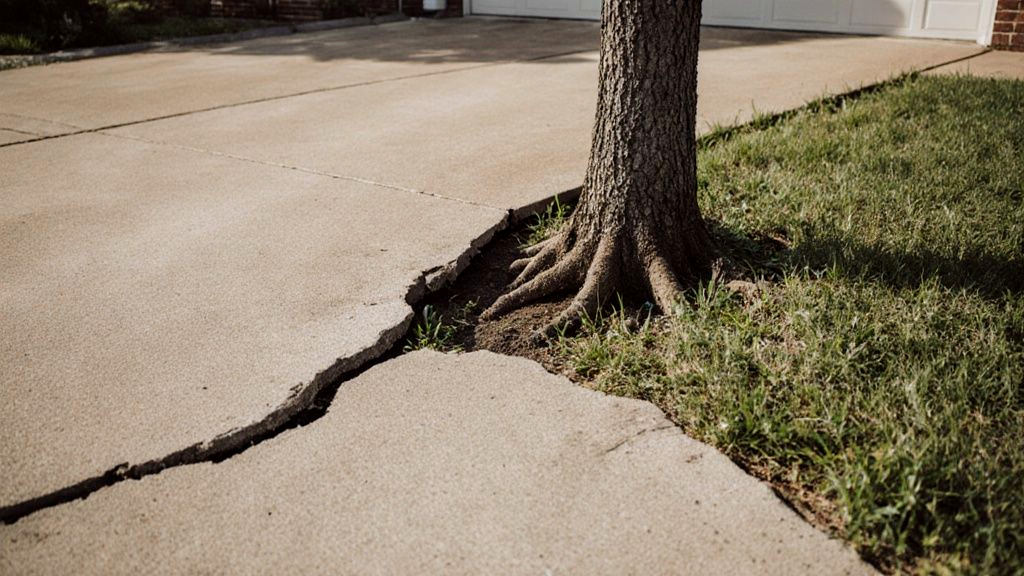
A driveway lifted and cracked by roots from a tree set too close: the bill for this arrives years after the planting decision.
A four-foot sapling near the driveway may look harmless today. Years later, roots may lift the slab or branches may crowd the vehicles parked below it.
Large shade trees generally need more distance from the house than smaller ornamental trees. A broad canopy tree may need to sit 15 to 20 feet or more from the foundation, depending on the species and site conditions. Smaller flowering or ornamental trees can often sit closer, but they still need enough room for mature spread.
Placement also depends on utilities.
Before planting trees or shrubs, homeowners should contact MLGW’s 811 guidance or call 811 so buried utilities can be marked. MLGW says every digging job requires a call, even for smaller projects like planting trees and shrubs.
That one step protects the homeowner, the crew, the property, and the neighborhood.
| Role in the plan | What it does | Placement rule of thumb |
|---|---|---|
| Large shade tree | Cools the house, anchors the yard, frames the view | 15 to 20+ ft from the foundation, clear of power lines |
| Ornamental / flowering tree | Seasonal color, smaller scale near entries and beds | 8 to 15 ft from structures; great near patios and walkways |
| Evergreen / screening tree | Privacy, wind block, year-round green | Along property lines, spaced for mature width |
| Existing mature tree | Instant shade and value you cannot buy new | Design beds, paths, and lighting to protect the root zone |
General guidance for the Memphis area. Exact spacing depends on species, soil, and how close your utilities and structures sit. We confirm it on site.
Designing Around the Trees You Already Have
Not every landscape plan starts with bare dirt. Many Memphis-area yards already have mature trees, and those trees are often the most valuable part of the property. A healthy old oak or shade tree gives a home character, cooling, privacy, and curb appeal that cannot be bought from a nursery.
The mistake is treating that tree like an obstacle. Homeowners sometimes trench through the root zone for irrigation, pile soil over the roots to level a bed, or pave too close to the trunk. The damage may not show immediately, but the tree can begin declining seasons later.
A better design works with the tree. That might mean raising the canopy slightly so more light reaches a planting bed. It might mean choosing shade-tolerant plants instead of fighting the shade. It might mean moving a patio edge, walkway, or trench outside the most sensitive root area.
This is where landscaping design services with real tree-care experience earn their keep. A design that looks good on paper is useless if it slowly kills the best tree on the property. If an existing tree needs structural pruning, our tree trimming services can help improve clearance, shape, and long-term health without turning the tree into a hacked-up mess.
Online Designer, Local Pro, or DIY?
Online landscape design can be useful for shaping bed layouts, plant palettes, visual style, and the overall yard plan. For homeowners who enjoy handling the installation themselves, it can be a solid starting point. But online plans have limits because they cannot fully judge drainage, soil, utilities, existing tree health, or how the property actually works in person.
A designer who has not walked the property may miss drainage problems, soil conditions, overhead line conflicts, buried utilities, or the true condition of existing trees. Those details decide whether the yard still works five, ten, or twenty years from now. DIY is fine for simple beds, mulch, and curb appeal updates, but it becomes risky when large trees, hardscape, utilities, or mature root systems are involved.
The strongest approach is often a hybrid. You can use an online plan or your own ideas for the visual direction, then bring in local landscaping design services for the tree placement, pruning, removal decisions, and major planting work. That gives you the creative direction you want without gambling on the expensive, hard-to-reverse parts.
Frequently Asked Questions
How far should a tree be planted from my house?
It depends on the mature size of the species, not the size of the sapling. As a general rule, large shade trees belong at least 15 to 20 feet from the foundation, with the biggest species pushed further out. Smaller ornamental and flowering trees can sit closer, around 8 to 15 feet. We confirm the right distance for your specific tree and lot during a free on-site estimate.
Can I add new trees to an established landscape without harming the old ones?
Yes, with care. The main thing is to keep digging, trenching, and fill soil out of the critical root zone of your existing mature trees. We plan new plantings and any hardscape so they protect the established root systems, since a healthy old tree is far more valuable than anything you can plant new.
Do you handle the whole landscape, or only the trees?
Both. We offer full landscaping in the Memphis area, from design and planting to ongoing maintenance, and we also work alongside homeowners who have their own plan and just want the tree placement, planting, and care handled by professionals. Tell us where you are in the process and we will fit in.
What if a tree is already in the wrong spot?
It depends on the tree and the problem. Sometimes a strategic trim or crown-raise solves the conflict with a roof or sight line. Sometimes the roots or location are causing real damage and removal is the honest call. We will tell you straight which one your situation needs at the estimate, with no pressure either way.
Let’s Get Your Trees in the Right Place
Whether you are starting from bare dirt or protecting a 50-year-old oak, the placement decisions are the ones worth getting right. We will walk your Memphis-area property, assess what you have, and help you build a plan around it. Free, no-pressure estimates.
Call (901) 282-9226