
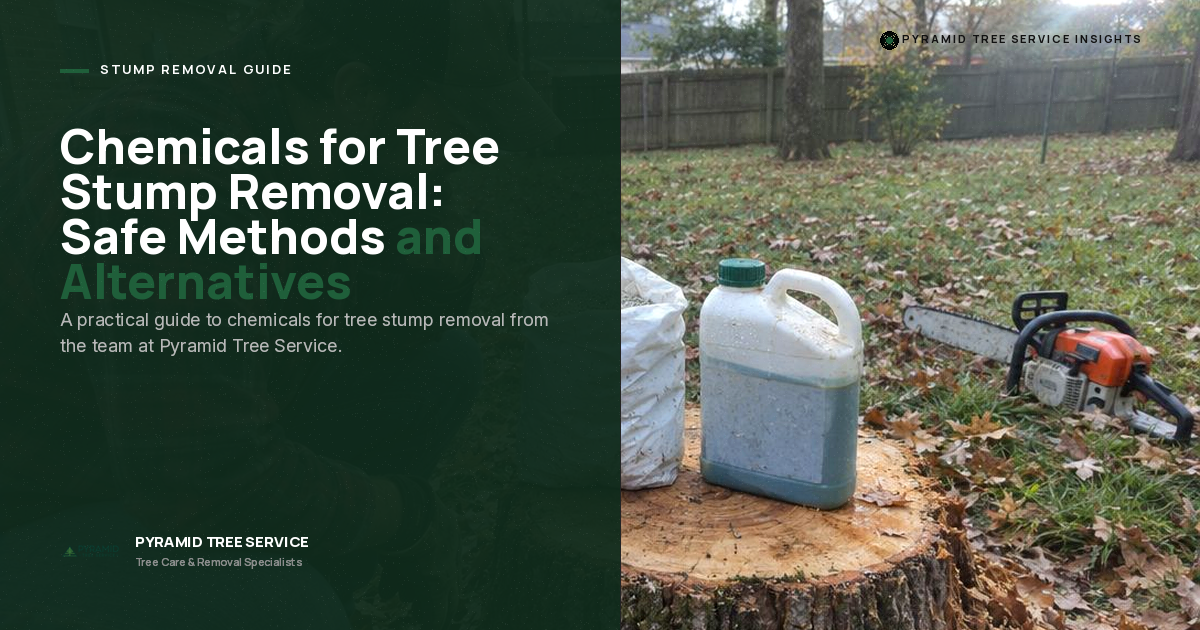
Chemicals for Tree Stump Removal: A Safe, Complete Guide to Methods and Alternatives
If you are weighing chemicals for tree stump removal, start with this: no bottle, bag, or powder actually dissolves a stump on contact. The confident promises you read on forums leave that part out. Some products speed up the natural rot a stump would go through anyway, and others kill the living tissue of a stump that keeps sprouting. Both can work, but each comes with a timeline measured in months and a set of safety rules most guides gloss over. After two decades of stump work across Memphis and North Mississippi, here is an honest look at the main options, how to use them without hurting your yard or yourself, and the point where a grinder simply makes more sense.
- No stump chemical melts wood. They either accelerate decay (potassium nitrate) or kill living tissue (herbicides).
- Expect six to twelve months for a treated stump to soften enough to break apart, and longer for dense hardwoods.
- Potassium nitrate is a strong oxidizer and herbicides are regulated pesticides, so storage and handling matter.
- Epsom salt and rock salt are the gentlest options but also the slowest and least reliable.
- Large stumps, anything near your home, or a spot you need back this season are grinder jobs, not chemical jobs.
How Chemicals for Tree Stump Removal Actually Work
There are really two different jobs people are trying to do, and confusing them is where most mistakes start. The first job is getting rid of a dead stump that is just sitting in the yard. The second is stopping a stump that keeps throwing up green shoots because the root system is still alive. Those two problems call for two completely different chemicals, and a product aimed at one will not do much for the other.
For a dead stump, the goal is faster decay. Nitrogen-rich products like potassium nitrate feed the bacteria and fungi that break wood down in nature. A fresh stump is starved of the nitrogen those organisms need, which is why an untreated stump can sit for five to ten years before it crumbles. Flood the wood with nitrogen and you remove that bottleneck. For a living, sprouting stump, the goal is the opposite: an herbicide such as glyphosate or triclopyr, painted onto the fresh cut, travels down into the roots and kills the tissue so it stops regrowing. It does not make the wood disappear either; it just stops the fight.
The Main Chemical Options, Compared
Walk the stump-remover aisle and you will see a handful of products dressed up with different branding, but they come down to four real categories. Here is what each one does, how long it takes, and the trade-off.
| Option | What it does | Typical timeline | The catch |
|---|---|---|---|
| Potassium nitrate | Adds nitrogen to speed natural decay of dead wood. | 6 to 12+ months | Strong oxidizer; patience required; not for living stumps. |
| Glyphosate or triclopyr herbicide | Kills a living, sprouting stump at the roots. | Weeks to kill, then it still must rot | Must be applied to a fresh cut; a regulated pesticide. |
| Epsom salt | Draws moisture out and slowly dries the wood. | 8 to 12+ months | Slow and inconsistent, especially in humid climates. |
| Rock salt | Dehydrates and kills the stump over time. | Several months to a year | Salt can leach into soil and harm nearby plants. |
Dense Memphis-area hardwoods such as oak, hickory, and pecan routinely take the long end of every range above.
None of these chemicals for tree stump removal are fast, and the gentlest ones (Epsom and rock salt) trade speed for being easier on the wallet. If you go the salt route, keep it strictly inside drilled holes so it does not bleed into the surrounding root zone and scorch your lawn. For a full walk-through of the most popular accelerant, our full guide to potassium nitrate stump removal covers the hole-drilling pattern, dosing, and re-wetting schedule step by step.

Safety Rules You Cannot Skip
Most guides treat this as a harmless garden chore, and that is exactly where people get hurt or damage their property. Each chemical carries a different hazard, so match your precautions to the product in your hands rather than assuming one set of rules covers all of them.
- Potassium nitrate is an oxidizer. It does not burn by itself, but it feeds and intensifies any fire it touches. Store it sealed, cool, and dry, far from fuel, fertilizer, and anything flammable.
- Herbicides are regulated pesticides. Read and follow the product label exactly; it is the legally binding instruction set. Apply to the cut within minutes while the surface is fresh, and never on a windy day near a garden or water.
- Think hard before you burn a treated stump. A nitrate-soaked stump burns hot and unpredictably, fire can travel underground through roots, and open burning is restricted across most of the Memphis area.
- Keep salt away from the root zone. Rock salt and Epsom salt can leach through soil and kill nearby grass, shrubs, and even neighboring trees.
- Protect kids and pets. Cover treated holes, fence off the area, and wear goggles, gloves, and a mask whenever you pour or paint.
Before you open any container, spend five minutes with the label. The U.S. Environmental Protection Agency explains why the pesticide label is a legal document and how to read it correctly at the EPA’s guide to pesticide labels. That one habit prevents the overuse, bad mixing, and runoff that cause the most trouble in home stump projects.
A Realistic Timeline and What to Expect
The single most common complaint we hear is that it feels like nothing is happening. That is normal. Whether you chose an accelerant or an herbicide, the surface of the stump looks almost unchanged for the first couple of months while the real work happens out of sight: nitrogen spreading through the fibers, or the herbicide moving down into the root system.
With potassium nitrate, the outer wood usually starts to soften and darken somewhere around months two to four, becomes spongy most of the way through by months four to eight, and is ready to break apart with a mattock by the time you reach eight to twelve months. With an herbicide, the stump itself can be dead within a few weeks, but that only stops the sprouting; you still have a solid stump to either rot out or grind. If a timeline measured in seasons does not fit your plans, that is the clearest signal that a chemical is the wrong tool for your situation.

When to Skip the Chemicals and Grind Instead
Choosing chemicals for tree stump removal honestly comes down to the stump in front of you, not a product label. A small, dead, out-of-the-way stump when you are in no hurry is a reasonable candidate for a bag of granules and a lot of patience. In plenty of other situations, though, the chemical route costs you a year and still leaves work to do. Reach for a professional when any of these are true:
- The stump is large or a dense hardwood. Oak, hickory, and pecan over about eighteen inches across can shrug off chemical decay for well over a year.
- It sits near your house, driveway, fence, or utilities. Soaking wood and roots next to structures, then possibly involving fire or salt, is not a risk worth taking.
- You need the spot back soon for grass, a patio, replanting, or a project this season.
- You have several stumps. Each one has to be treated separately, while a grinder clears them all in a single visit.
In all of those cases, grinding is faster, cleaner, and finished the same day. Our professional stump grinding services take a stump and its surface roots eight to twelve inches below grade in well under an hour, leaving the spot immediately usable for sod or planting. If the tree is still standing or only partly down, we also handle complete tree removal and stump elimination in one coordinated job. And if you want to see every option side by side before you decide, our guide to DIY versus professional stump removal methods compares chemicals, grinding, digging, and excavation on cost, time, and risk.
Rather skip the year of waiting?
Free estimates and same-week stump grinding across Memphis and North Mississippi.
Chemical Stump Removal Questions We Hear Most
What is the best chemical to kill a tree stump for good?
It depends on your goal. To stop a living stump from sprouting, a glyphosate or triclopyr herbicide painted on the fresh cut is the most effective. To speed the breakdown of a dead stump, potassium nitrate is the standard choice. Neither one makes the wood vanish, so you will still break it up or grind it out afterward.
How long do chemicals take to rot a stump?
Plan on six months at the absolute minimum and a full year or more for hardwoods in our humid climate. Accelerants speed up natural decay, which is a biological process that moves at its own pace no matter how much product you add. Epsom salt and rock salt usually run even slower.
Will stump chemicals hurt my surrounding lawn or plants?
They can. Salt leaches through soil and scorches nearby grass and shrubs, and herbicide overspray or runoff kills whatever it lands on. Nitrogen spills can burn turf too. Keep every product strictly inside the drilled holes, cover the stump, and rinse any granules that miss.
Is grinding better than using chemicals for tree stump removal?
For most homeowners, yes. Grinding is done in under an hour, the spot is usable the same day, and there is no chemical to store or child-proof. Chemicals make sense mainly for a small, dead, out-of-the-way stump you are in no rush to clear. For anything large, near structures, or needed back this season, grinding wins on time and safety.
Should I burn the stump after treating it with chemicals?
We advise against it. A chemically treated stump, especially one soaked with potassium nitrate, burns hot and unpredictably, fire can smolder along roots underground and surface feet away, and open burning is restricted across most of the Memphis area. The small savings are not worth a fire that gets away from you.
Stump still standing? Let us finish it this week.
Chemistry takes a year. A grinder takes an afternoon. If you would rather skip the wait, we will walk your property, give you a free no-pressure estimate, and have most stumps gone within the week.