
Tree Removal Close to Me: A Complete Expert Guide to What to Expect and When to Call
When a homeowner types “tree removal close to me” into their phone, it is almost always after something has already gone sideways. A trunk leaning over the driveway after last night’s storm, a dying oak crowding the power line, a stump that finally lost its war with carpenter ants. We see all of it across Memphis and North Mississippi, and after twenty plus years on the saw end of a rope, the same questions come up every time. What actually happens during a removal? Is the price reasonable? When can a tree wait, and when should it absolutely not? This guide answers each of those in plain language so you know exactly what to expect before you ever pick up the phone.
- Most removals follow the same four phases: assessment, rigging, sectional cutting, and cleanup.
- A leaning tree, large dead limbs, root damage, or any contact with power lines means it is time to call.
- Cost is driven by tree size, access, proximity to structures, and whether you want the stump ground out.
- Always hire a licensed and insured crew. The cheapest quote almost always carries the highest hidden risk.
- Storm damage and trees on structures are emergencies. Call right away, day or night.
When You Need Tree Removal Close to Me Right Away
Some trees can wait until next month for a planned removal. Others should not stay standing one more night. The difference matters because waiting on a hazardous tree often turns a routine job into an insurance claim. After every line of storms that rolls through the Mid-South, we get a wave of calls from homeowners who had been “watching” a problem tree for a year and finally lost the gamble.
Treat any of the following as a same-day call:
- The tree is leaning where it was not before. A new lean, especially with cracking or lifting soil at the base, means the root plate is failing.
- A large limb has split partway off the trunk. Hanging limbs (“widow makers”) drop without warning and weigh more than most homeowners realize.
- Branches are touching power lines. Limbs on energized lines are an outage and fire hazard. Do not cut these yourself, ever.
- A storm has already brought the tree down. If anything is on a roof, fence, vehicle, or driveway, it needs immediate, controlled removal so the damage does not get worse.
- You hear cracking from the canopy in calm weather. Internal failure is happening and the next gust may finish the job.
For these situations, we run emergency tree removal services across Memphis and North Mississippi. A crew can be on site the same day, often within a few hours, with the rigging gear and bucket truck needed for tight residential work.
What Professional Tree Removal Actually Looks Like
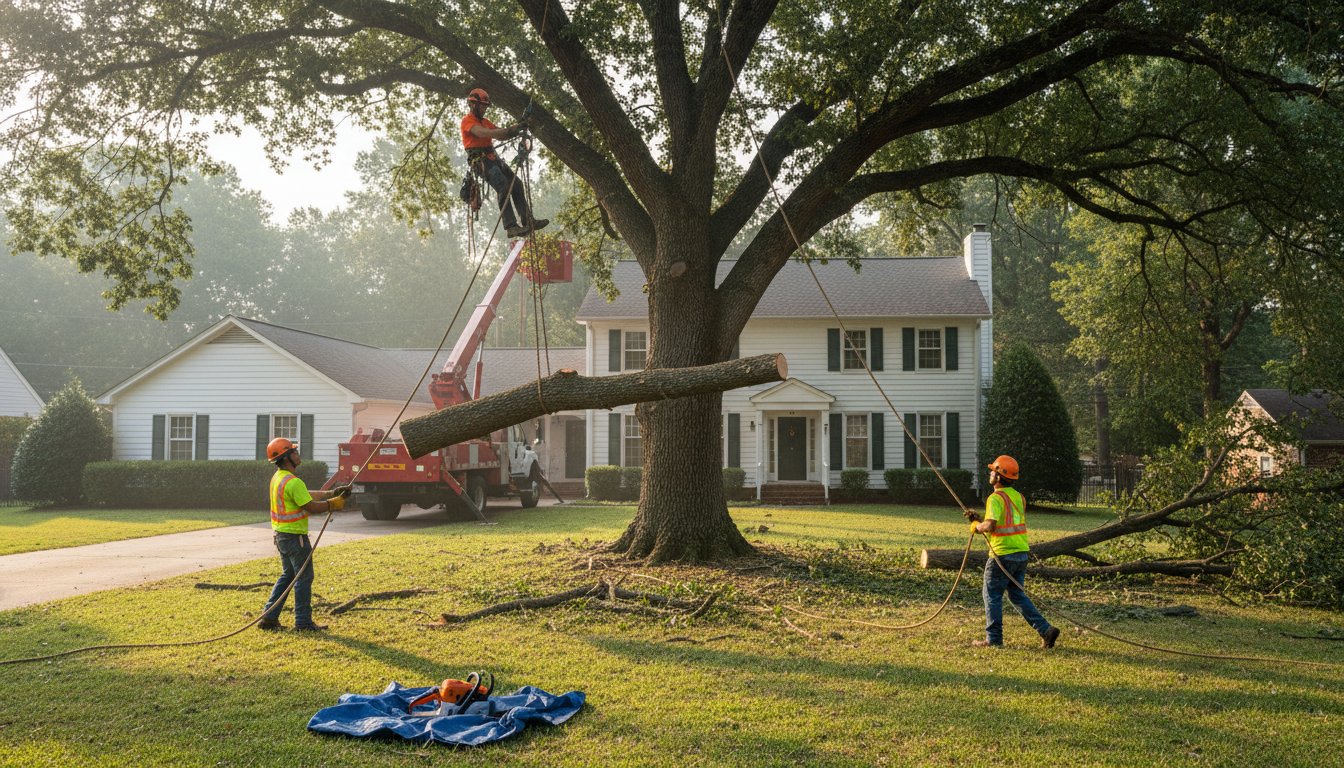
The first time you watch a removal up close, the choreography is the surprising part. A good crew does not just “cut down a tree.” They take it apart in a sequence that controls every piece of weight on the way down. Here is how a typical job runs from start to finish.
1. Assessment and Free Estimate
Before any saw comes out of the truck, the crew lead walks the property. They look at the tree’s lean, its health, the surrounding structures, the access for trucks, and where the wood and brush will land. You get a written quote with the scope spelled out: removal only, removal plus stump grind, hauling vs. leaving wood for firewood, and so on. A good estimate has no surprises baked in.
2. Setup and Safety Zone
On the day of work, the crew tarps the lawn and flower beds, sets cones in the street if needed, and calls in any utility locates if stump grinding will go deep. Climbers gear up with helmets, eye and ear protection, cut-resistant chaps, and the climbing harness with all its rigging hardware. The ground crew sets up rope anchors and stages the chipper.
3. Sectional Removal
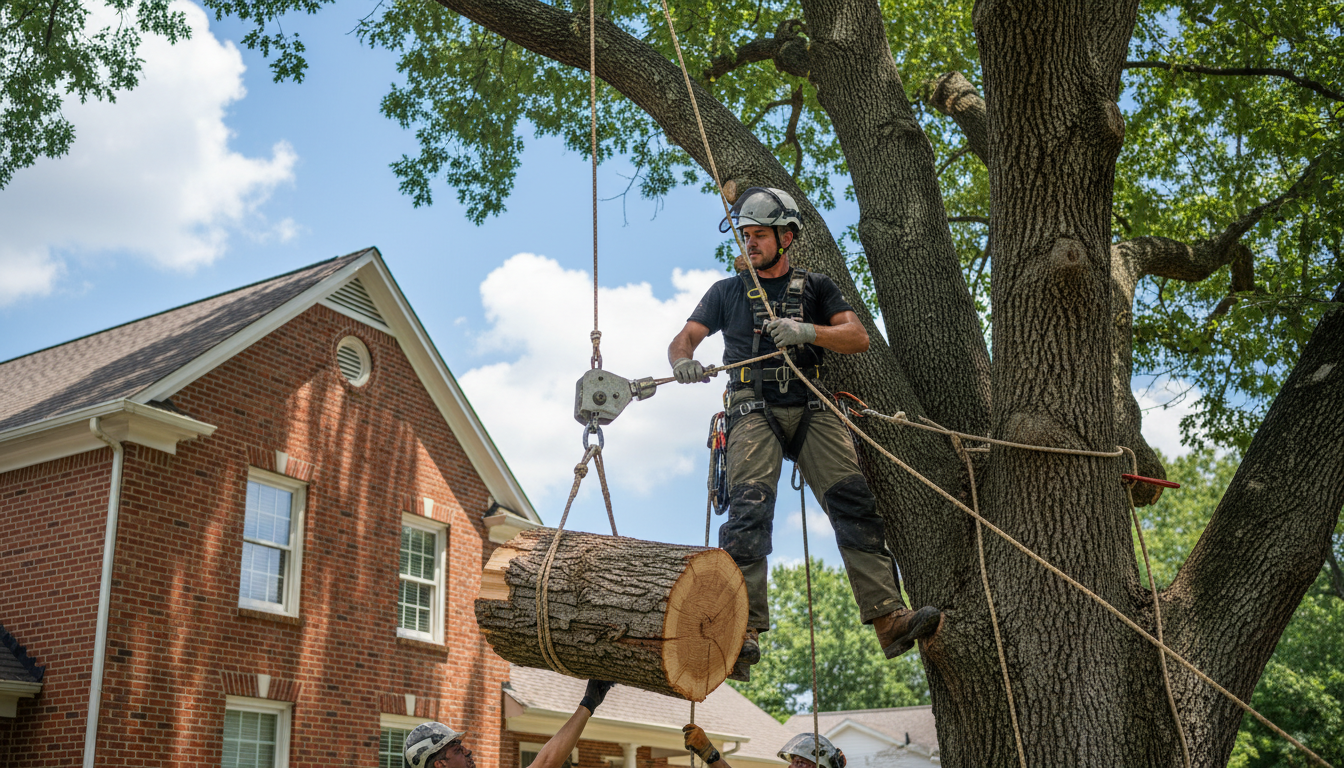
For any tree near a structure, “sectional removal” is the name of the game. A climber goes up with a small saw and ropes, and the tree comes down in chunks: outer branches first, then larger limbs, then sections of the trunk. Each piece is roped off, lowered with a controlled friction system, and guided to a designated drop zone. This is slower than felling the whole tree, but it is the only safe way to work around houses, garages, fences, and power lines.
4. Wood Removal, Cleanup, and Optional Stump Grinding
Brush goes through the chipper. Logs go on the truck or are cut to firewood length and stacked where you ask. The crew rakes the area, blows the driveway, and walks the yard for stray sticks. If you have ordered stump grinding, that grinder rolls up and reduces the stump and visible roots to wood chips a few inches below the soil line. You are left with a clean yard and a quick path to replanting grass or installing something new.
Safety Considerations Most Homeowners Underestimate
Tree work shows up in industry safety reports as one of the most dangerous jobs in the country. The Bureau of Labor Statistics consistently ranks tree trimmers and loggers near the top for fatal injuries, and the cause is almost always the same combination: heavy weight under tension, falling distance, chainsaws, and proximity to lines and structures. None of that scales down on a homeowner’s property just because the tree is in your yard instead of a logging operation.
The two failure modes we see most often when a DIY removal goes wrong are:
- Misjudged falling weight. A 12-inch limb that looks light from the ground can weigh several hundred pounds. Once it starts moving, gravity is in charge, not the rope.
- Kickback and pinching. A chainsaw blade pinched in a piece of trunk under tension can buck violently. Without proper chaps and a saw with a working chain brake, even an experienced sawyer can be hurt.
If you want a useful baseline on how this work should be done, the International Society of Arboriculture publishes industry standards and a public-facing arborist directory at TreesAreGood.org. Any reputable crew you hire should be able to point to ISA certification, written safety procedures, and current liability and workers’ compensation insurance.
Cost Factors and What to Budget
The single most common question we field on the first phone call is some version of “how much?” The honest answer is that it depends on five things, and any quote you get without those factors examined is a guess. Here is the actual price math behind a residential job.
| Cost Driver | What Moves the Price | Typical Impact |
|---|---|---|
| Tree size | Height, trunk diameter, total wood volume | Largest factor |
| Access | Can a bucket truck reach it, or does everything climb? | Significant |
| Proximity to structures | House, fence, pool, neighbor’s roof, power lines | Significant |
| Health and condition | Sound wood vs. rotten or hollow trunk | Moderate |
| Cleanup scope | Haul everything, leave firewood, grind stump | Adjustable |
For a Memphis-area homeowner in 2026, ballpark ranges look like this. A small tree under 25 feet runs about 250 to 500 dollars. A medium 25 to 50 foot tree, like a young oak or sweetgum, lands in the 500 to 1,000 range. Mature 50 to 75 foot specimens are typically 1,000 to 1,800. Anything 75 feet and up, or any tree directly over a structure, is custom quoted because the rigging plan changes the labor entirely. Stump grinding usually adds 75 to 300 dollars depending on diameter.
Beware of any quote that comes in dramatically below the rest. Either the crew is uninsured, planning to leave the wood for you to deal with, or rushing the rigging in a way that increases the chance of property damage. Cheap tree work is the most expensive tree work there is.
How to Pick the Right Crew for the Job
The Memphis area has plenty of folks willing to show up with a chainsaw and a pickup. Picking a real professional tree removal company instead of a chainsaw-and-a-truck operation comes down to a short checklist. Run through it before you sign anything.
- Liability and workers’ comp insurance, in writing. Ask for current certificates emailed to you. If the crew is hurt or your house gets damaged, this is what protects your wallet.
- Local references and reviews. A few years of solid Google reviews from your zip code beats a slick out-of-town flyer every time.
- A written estimate. “We will figure it out” is not a quote. The number, the scope, and the cleanup expectations should all be on paper.
- Right gear for your tree. If your tree needs a bucket truck or crane and the crew shows up with a single ladder, the job is going to go badly.
- Honest about limits. A good crew tells you when a job is outside their wheelhouse. Be skeptical of anyone who says yes to everything.
Need a tree looked at this week?
Free, no-obligation estimates across Memphis and North Mississippi.
Frequently Asked Questions
How quickly can a crew get out for a tree removal close to me?
For non-emergency removals, most reputable crews in the Memphis area can schedule within a few days to about two weeks, depending on time of year. Storm season ramps the wait up. For genuine emergencies (tree on a structure, leaning over a driveway, blocking a road), we run same-day response and routinely have a crew on site within a few hours.
Do you need a permit to remove a tree in Memphis?
For most residential properties on private land, no permit is required. Some HOA-governed neighborhoods have their own rules, and certain protected heritage trees can have extra requirements. We check this for you during the estimate so you do not get a surprise notice from the city or your HOA.
Will my homeowners insurance cover the removal?
If a tree falls on a covered structure (your house, garage, or fence), most policies cover the removal as part of the claim, including hauling. If the tree falls in your yard without hitting anything, removal is usually on you. We document conditions, take before-and-after photos, and itemize work in a way that adjusters accept.
Can you remove a tree right next to my house or power line?
Yes. Tight, structure-adjacent removals are a big share of what we do. We use ropes, friction lowering devices, and a bucket truck where access allows, taking the tree apart in pieces rather than felling it whole. For trees on energized lines, we coordinate with the local utility before any climbing begins.
Should I grind the stump or leave it?
It depends on what you want to do with the spot. If you plan to replant grass, install a flower bed, or build anything over it, grind it. If you are happy to leave a low stump as a natural feature in a back corner of the yard, leaving it is fine. Grinding usually takes 30 to 90 minutes per stump and we can do it the same day in most cases.
What happens to the wood after removal?
That is your call. We can haul everything off, cut and stack the trunk into firewood lengths, or chip the brush and leave a pile of mulch you can use in beds. Each option changes the price slightly, and we lay it out clearly in the estimate so you can choose what makes sense for your yard.
Get a free, no-pressure estimate today.
If a tree on your property is starting to worry you, the smartest first move is a free in-person assessment. It costs nothing, takes about 20 minutes, and you walk away with real answers from someone who climbs trees for a living.