
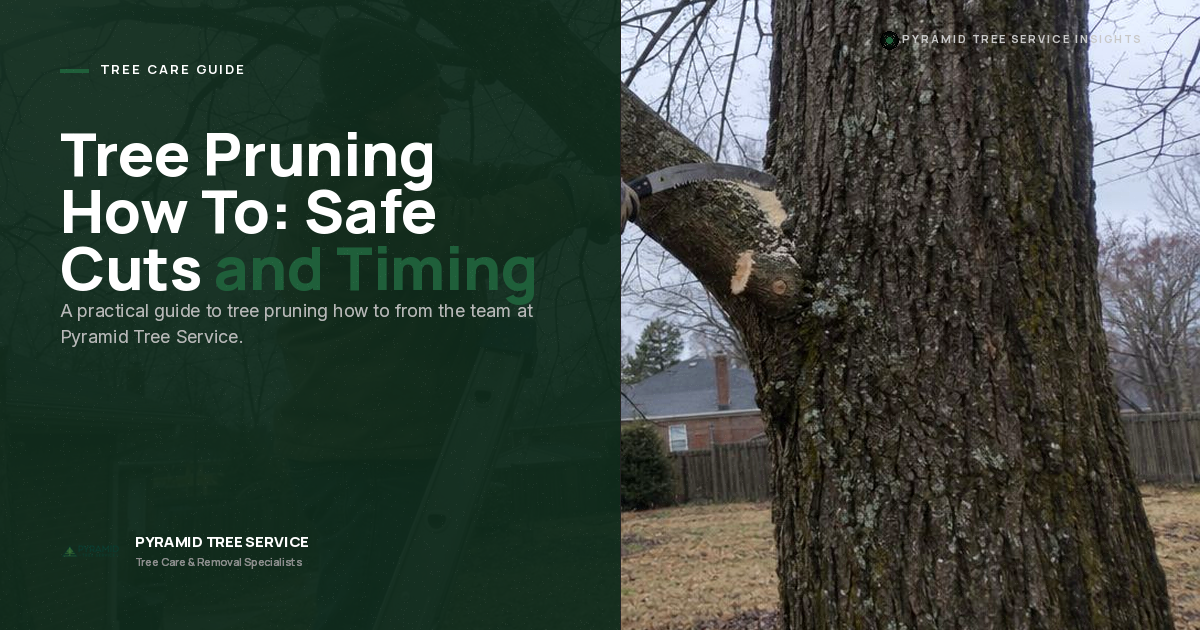
Tree Pruning How To: A Proven Expert Guide to Safe Cuts and Timing
Most trees are not harmed by too little pruning, they are harmed by the wrong cut in the wrong place at the wrong time of year. That is the single idea behind this tree pruning how to guide: a few sound rules, applied with restraint, will do more for a tree than a weekend of aggressive sawing ever could. Here is exactly when to prune, where to make the cut, and how the pros around Memphis approach it.
- Late winter, while the tree is dormant, is the best window for most pruning.
- Cut just outside the branch collar, never flush to the trunk and never leaving a long stub.
- Remove dead, damaged, and crossing branches first, then thin for light and air.
- Never take more than about a quarter of the live canopy in a single year.
- If the work needs a chainsaw overhead or is near a power line, call a professional.
Why Proper Pruning Matters
Pruning is the most common thing homeowners do to their trees, and the most commonly done wrong. A good cut heals cleanly, steers growth where you want it, and lets the canopy breathe. A bad cut invites decay, creates weak attachment points, and can set a young tree on a path toward failure twenty years later.
There are three reasons to prune, and keeping them straight tells you what to cut. The first is health: removing dead, diseased, or broken wood before problems spread. The second is structure: training young trees so they grow with strong, well-spaced branches instead of tight, weak forks. The third is safety and clearance: keeping limbs off the roof, away from power lines, and out of walkways.
Notice what is not on that list. Pruning for looks alone, or simply to make a tree smaller, is where most damage happens. A tree is not a hedge. Every leaf it carries is feeding it, so the goal is always to remove the least amount of living wood needed to meet a real objective.
When to Prune: Timing Guidelines That Protect the Tree
Timing is half the job. The same cut that helps a tree in February can stress it in September.
For the large majority of shade and ornamental trees, late winter to very early spring is the ideal window. The tree is dormant, its energy is stored in the roots, and the wounds you make will close quickly once growth resumes in spring. You can also see the branch structure clearly with the leaves gone, which makes it far easier to choose the right cuts.
There are important exceptions. Trees that flower in early spring, like dogwood and redbud, set their buds the previous year, so pruning them in winter removes the coming show of blooms. Prune those just after they finish flowering instead. Oaks are the opposite case and deserve real caution: in our region, pruning an oak during the warm growing season can attract the beetles that spread oak wilt, so oaks are best pruned in the depth of winter.
| Timing | Best for | Why |
|---|---|---|
| Late winter / dormant | Most shade trees, oaks, structural pruning | Fast wound closure, visible structure, lowest disease risk |
| Just after bloom | Spring-flowering trees (dogwood, redbud, cherry) | Protects next year’s flower buds |
| Summer (light only) | Removing dead or broken limbs, minor clearance | Slows regrowth, but avoid heavy cuts in heat |
| Anytime | Clearly dead, hazardous, or storm-damaged wood | Safety always comes before the calendar |
The one rule that overrides the calendar: dead and hazardous limbs can come off at any time of year. A cracked branch hanging over the driveway does not wait for February.
Tree Pruning How To: The Core Steps, Done in Order
The tree pruning how to process always follows the same logic, whether you are shaping a young crape myrtle or thinning a mature oak. Work through the branches in priority order, make each cut in the right spot, and stop before you overdo it.

- Clean and sharpen your tools first. Use bypass hand pruners for small growth, loppers for mid-size branches, and a pruning saw for anything thicker than your thumb. Wipe the blades with rubbing alcohol before you start, and again if you move to a tree that looks diseased, so you do not carry problems from one tree to the next.
- Take the dead, damaged, and diseased wood first. Walk the tree and remove anything brown, broken, or clearly sick before you make a single shaping cut. Often this alone is all a healthy tree needs, and it lets you see what is really left to work with.
- Remove crossing and rubbing branches. Where two limbs rub, they wear through the bark and open a wound. Choose the stronger, better-placed branch and remove the other.
- Find the branch collar before every cut. That slightly swollen ring where a branch meets the trunk is the tree’s healing tissue. Cut just outside it. Cutting flush into the trunk removes that tissue and leaves a wound the tree cannot seal, while leaving a long stub gives decay a place to start.
- Use the three-cut method on anything heavy. For a branch big enough to tear, make a small undercut a foot out from the trunk, then a second cut just beyond it to drop the weight, then a final clean cut at the collar. This keeps the falling limb from stripping bark down the trunk.
- Step back often and stop early. Pruning is subtractive, so you cannot put a branch back. Look at the whole tree between cuts, and when you have met your objective, put the saw down. A tree that still looks natural when you finish is a tree pruned correctly.
Skip the wound paint. Older advice told homeowners to seal every cut with tar or pruning paint. Research has moved on: a clean cut outside the branch collar seals itself better than any dressing, and sealers can actually trap moisture and slow healing. Make the right cut and let the tree do the rest.
The Main Types of Pruning Cuts
Professional pruning comes down to a handful of recognized techniques, each with a clear purpose. Knowing which one you need is the part of any tree pruning how to routine that separates a clean job from a damaging one.
Cleaning
The simplest and safest technique: removing dead, dying, diseased, and broken branches throughout the crown. Nearly every tree benefits from cleaning, and it carries almost no risk of harming a healthy tree because you are only taking wood the tree has already lost.
Thinning
Selectively removing live branches to let more light and air move through the canopy. Good thinning reduces wind resistance and disease pressure, but it is easy to overdo. Thin from the edges of the crown, keep the cuts spread out, and resist the urge to strip the interior bare, a mistake called lion-tailing that actually weakens limbs.
Raising
Removing the lowest branches to create clearance over a sidewalk, driveway, or roofline. Raise gradually over a few seasons on a young tree, and never strip so many low limbs that the trunk is left bare and top-heavy.
Reduction
Shortening a limb back to a healthy lateral branch large enough to take over as the new leader. Reduction is how a trained pruner lowers height or spread without the ugly, damaging stubs left by topping. It takes skill, and on a large tree it is a job for a professional.
Branch too high or too heavy to reach safely?
Our professional tree trimming services bring the ladders, saws, and trained crew to your yard.
Common Pruning Mistakes to Avoid
Almost every damaged tree we are called out to rehabilitate shows one of the same few errors. Avoid these and you avoid most of the trouble.

Topping the tree
Cutting main limbs back to stubs to reduce height is the single worst thing you can do to a tree. It triggers a rush of weak, upright shoots called water sprouts, leaves large wounds that rarely seal, and creates a taller, more hazardous tree within a few years. If height is a real problem, reduction or removal is the honest answer, never topping.
Cutting flush to the trunk
A flush cut removes the branch collar, the very tissue the tree uses to wall off the wound. The result is a large opening that decay walks right into. Always leave the collar.
Taking too much at once
A healthy mature tree should lose no more than about a quarter of its live canopy in a single year, and often much less. Strip away more and you starve the tree of the leaves it needs to feed itself, which triggers stress growth and invites pests.
Pruning with dull or dirty tools
A ragged, crushed cut heals far slower than a clean one, and an unsanitized blade can carry disease from a sick tree to a healthy one. Sharp, clean tools are not a detail, they are part of the technique.
When to Call a Professional
A great deal of pruning is a reasonable do-it-yourself project: deadwood you can reach from the ground, shaping a young tree, clearing a low branch over the walk. The tree pruning how to basics stay the same at any scale, but the risk does not.
Call in a trained crew when the work means a chainsaw over your head, a ladder leaned against the trunk, or any branch near a power line. Overhead saw work is one of the most common ways homeowners are seriously hurt in the yard, and utility lines are never a do-it-yourself situation. Large reduction cuts, storm-damaged limbs under tension, and anything requiring a bucket truck or climbing gear all belong with professionals.
Our certified arborists prune trees across the Memphis metro and North Mississippi with the tree’s long-term health as the goal, not just a quick trim. If you are weighing routine upkeep against a bigger job, our breakdown of tree trimming and pruning differences helps you know what you are actually asking for, and the same cut-placement rules carry straight over to a focused project like pruning an apple tree. For a neutral, research-backed reference on cut placement and timing, the University of Minnesota Extension pruning guide is an excellent resource.
Frequently Asked Questions
What is the best time of year to prune a tree?
For most shade and ornamental trees, late winter while the tree is dormant is ideal. Wounds close fast once spring growth begins, and the bare branches make structure easy to read. The main exceptions are spring-flowering trees, which you prune right after they bloom, and dead or hazardous limbs, which can be removed any time.
How much of a tree can I safely prune at once?
No more than about a quarter of the live canopy in a single year, and usually less on an older tree. Removing more forces the tree to burn stored energy and often triggers weak, excessive regrowth. If a tree needs more work than that, spread it across two or three seasons.
Should I put sealant or paint on a pruning cut?
No. A clean cut made just outside the branch collar seals itself better than any dressing. Wound paints and tars can trap moisture and slow natural healing. The only real exception is oaks pruned during the growing season, where a thin coat can help deter the beetles linked to oak wilt, which is one more reason to prune oaks in winter instead.
Do you prune trees in the Memphis area?
Yes. We prune shade trees, ornamentals, and fruit trees throughout Memphis and North Mississippi, including Olive Branch, Southaven, Hernando, and Horn Lake. We are fully licensed and insured, and estimates are always free. Call (901) 282-9226 to set one up.
Want it pruned right the first time?
Whether a single limb is threatening the roof or a whole canopy needs careful thinning, our crew will assess it honestly and prune only what the tree needs. Free estimates across Memphis and North Mississippi.